Casablanca: European Union Ambassador Dimiter Tzantchev Praises the Remarkable Development of Economic Relations Between Morocco and the EU
The Ambassador of the European Union (EU) to Morocco, Dimiter Tzantchev, praised the remarkable success of economic relations between the Kingdom and the Union on Monday in Casablanca.

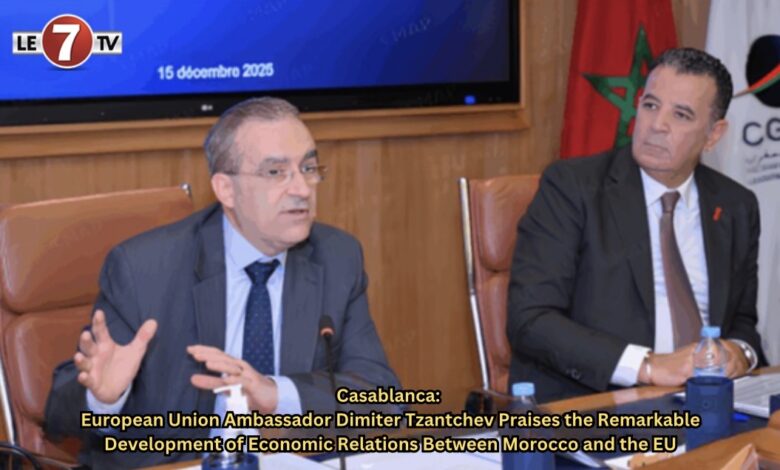
Speaking at a meeting with the General Confederation of Moroccan Enterprises (CGEM), Mr. Tzantchev noted that these relations have allowed bilateral trade to increase fivefold in 25 years, generating prosperity and jobs on both sides of the Mediterranean.
In this regard, he recalled that the EU remains today the leading supplier, customer, and foreign investor in Morocco.
Mr. Tzantchev congratulated the Kingdom on the scale of its economic and institutional evolution, observing a profound and remarkable transformation at all levels.
For his part, the President of the CGEM, Chakib Alj, emphasized the particular importance given by the Moroccan private sector to Morocco–EU relations, which are experiencing sustained dynamism in commercial exchanges, with an intensification of flows and a notable upscaling of Moroccan production.
“The European Union remains the Kingdom’s main partner, representing 56% of Moroccan trade in products and absorbing 65% of exports, with the total value of exchanges increasing by nearly 40% in recent years,” he specified.
Mr. Alj also highlighted the scope of the new agreement concluded in October 2025 between Morocco and the EU, which he described as a structuring milestone in the bilateral relationship. He cited various high-potential areas of cooperation, including green hydrogen and renewable energies, integrated industrial value chains, research and development, innovation and training, as well as sustainable agriculture.
For him, this agenda constitutes a robust, though perfectible, basis for deepening the privileged relationship between the two shores of the Mediterranean.
Furthermore, the President of the CGEM affirmed that the current dynamic between Morocco and the EU creates the conditions for a renewed, balanced, and promising partnership, relying notably on the October 2025 agreement, the recent vote on the delegated act, the implementation of the New Mediterranean Pact, and support for the UN Security Council resolution on the Moroccan Sahara.
He assured that the Moroccan private sector is fully mobilized to accompany this movement, reaffirming the CGEM’s commitment to working towards the lasting anchoring of this partnership in shared prosperity, economic stability, and innovation.
Held on the sidelines of the CGEM Board of Directors meeting, this session was a privileged opportunity to present the strategic stakes and perspectives for the evolution of the Morocco–EU partnership, exchange views on economic, commercial, and investment cooperation opportunities, and identify common priorities for strengthening collaboration between the Confederation and European institutions.
Editorial team/le7tv