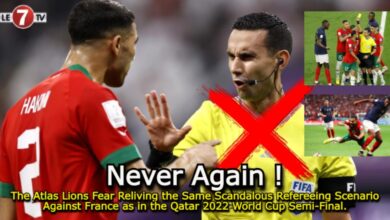
Refereeing: The Major Concern Seriously Worrying the Atlas Lions Ahead of the Morocco–France Clash


As Morocco prepares to face France in the quarter-finals of the 2026 FIFA World Cup, one issue has overshadowed tactical discussions and player performances: refereeing. Since the start of the tournament, several officiating decisions have sparked intense debate, fueling a growing sense of distrust among many observers and supporters, particularly across Africa.
Modern football relies on advanced technologies designed to minimize errors, most notably the Video Assistant Referee (VAR) system. Yet controversies have continued to dominate the tournament, creating the perception that some of football’s traditional powerhouses benefit more readily from favorable decisions than others. Several matches at this World Cup have drawn strong criticism over the consistency of refereeing, particularly the Round of 16 encounter between France and Paraguay, which prompted widespread reactions in the international media as well as from former referees.
For Moroccan supporters, memories of the 2022 FIFA World Cup semi-final remain especially painful. A number of disputed incidents during the match against France sparked heated discussions, with many believing that several penalty-area situations deserved closer examination. Although FIFA has never acknowledged any official refereeing error capable of altering the outcome, the controversy remains deeply embedded in the collective memory of the Atlas Lions and their fans.
It is precisely this backdrop that has heightened concerns ahead of another meeting between the two nations. Morocco is not only wary of the quality of the French squad but also of the possibility that controversial refereeing decisions could influence what is expected to be an exceptionally close contest.
More broadly, many followers of African football believe that teams from the continent still struggle to receive the same treatment as some of Europe’s leading football nations during major international tournaments. Whether or not this perception is supported by objective statistical evidence, it has been reinforced by several World Cup editions in which disputed refereeing decisions have left a lasting impression.
Against this backdrop, the appointment of referees for the quarter-finals will be closely scrutinized. FIFA bears the responsibility of ensuring complete impartiality—not only in the decisions made on the field but also in how those decisions are perceived by millions of viewers around the world. The credibility of football’s most prestigious competition depends as much on the quality of its officiating as on the quality of the football itself.
The quarter-final between Morocco and France represents far more than a high-profile football match. It also serves as a significant test for the world’s refereeing authorities. Above all, the Atlas Lions want the assurance that their fate will be determined solely by their performance on the pitch, and not by decisions that could once again fuel controversy.
Abderrazzak Boussaid / Le7tv