Automotive industry: Morocco establishes itself as Africa’s leading powerhouse
In 2025, Morocco crossed a historic milestone by surpassing the threshold of one million vehicles produced, thus becoming Africa’s leading automobile manufacturer. This achievement marks a major turning point in the continent’s industrial hierarchy, ending South Africa’s long-standing supremacy. Above all, it illustrates the rise of a Moroccan industrial model built on attractiveness, stability and the anticipation of global shifts.

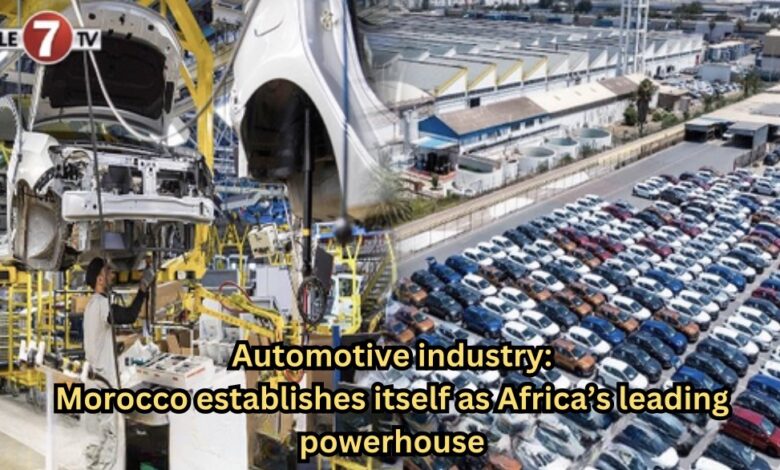
According to Africa Business Insider, this record volume was reached as early as the beginning of December 2025, driven by spectacular growth of nearly 79 percent compared with the whole of 2024, which had closed at just over 559,000 units. This rapid rise places the Kingdom far ahead of Pretoria, whose production, although increasing, was not enough to preserve its continental leadership.
South Africa remains an important player in the sector. Data from the National Association of Automobile Manufacturers of South Africa (Naamsa) show nearly 597,000 vehicles sold in 2025, an annual increase of more than 15 percent. However, this commercial momentum has not offset the gap opened up by Morocco, whose production lines are now operating at full capacity.
This success is the result of an industrial strategy patiently built over the past fifteen years. Almost absent from the global automotive map in the early 2010s, the Kingdom managed to attract major manufacturers thanks to a stable political climate, integrated industrial ecosystems and a clear incentive policy. The arrival of Renault in 2012, followed by Stellantis in 2019, marked key milestones, reinforced by a wide network of free trade agreements with the European Union, the United States and several Asian countries.
At the same time, Morocco made the strategic choice to position itself in the sectors of the future. The country committed early to electric mobility, with the assembly of the Opel Rocks-e model as early as 2021. From January 2026, Neo Motors is expected to launch the Dial-E, the first electric vehicle entirely designed and developed in Morocco, while Tesla has chosen the Kingdom as its first official base on the African continent.
By contrast, South Africa’s automotive industry continues to face structural weaknesses. Chronic difficulties in the power grid, marked by repeated load shedding, weigh heavily on production costs. Added to this are geopolitical and trade uncertainties that dampen investor enthusiasm, in a context where Europe and the United States remain essential markets.
One of Morocco’s major strengths also lies in its energy strategy. Massive investments in renewable energy guarantee a more stable and gradually decarbonised electricity supply, a decisive advantage for an automotive industry increasingly subject to strict environmental standards.
In the medium term, this momentum reinforces the Kingdom’s ambition to establish itself as a reference industrial platform between Europe and Africa, at the heart of an automotive sector undergoing major technological and geoeconomic transformation.
Editorial team/le7tv