Amal El Fallah Seghrouchni: Morocco Aims to Become an Arab-African Digital Hub in AI
Morocco is working to position itself as an Arab-African digital hub in the fields of artificial intelligence (AI) and advanced sciences, Minister Delegate in charge of Digital Transition and Administrative Reform Amal El Fallah Seghrouchni said on Wednesday in Salé.

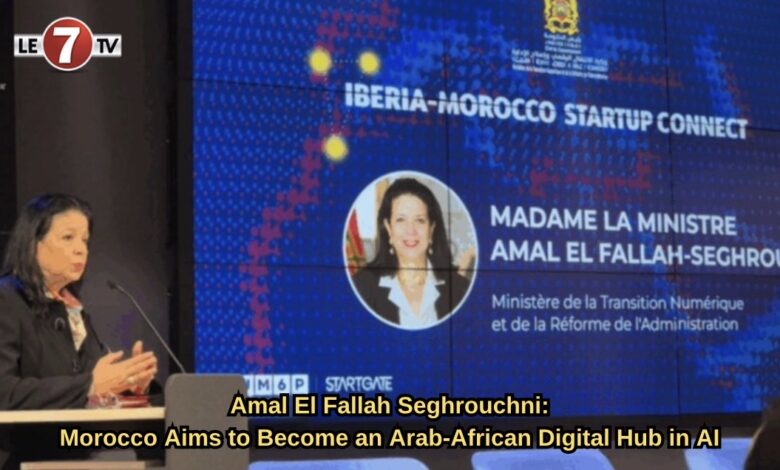
Speaking at the opening of “Iberia-Morocco StartUp Connect”, Ms. Seghrouchni stated that this represents a strategic orientation aimed at strengthening the Kingdom’s international competitiveness through innovation, research and the startup ecosystem.
She explained that this orientation stems from a vision designed to structure an ecosystem bringing together researchers, startups, public and private stakeholders, as well as contracting authorities, with the objective of fostering ideas, solutions and high value-added products, particularly in the field of AI.
In this regard, the minister underlined that this dynamic is based on an approach that promotes collaboration rather than silo-based work, citing in particular the Jazari Institutes initiative, which seeks to connect innovation with scientific research in order to enhance Morocco’s competitiveness at the international level.
Indeed, she noted that the innovation dynamic is part of a broader perspective of international cooperation, as illustrated by the opportunities offered through partnerships with Spain and Portugal within the framework of joint projects, including the 2030 World Cup, where technologies and startups are expected to play an important role.
The government official also announced the upcoming launch of a national initiative called “RamadanIA”, presented as a hackathon aimed at identifying useful innovations, including in remote areas, with a view to feeding the startup pipeline and supporting their development.
For his part, the Ambassador of Spain to Morocco, Enrique Ojeda Vila, highlighted the dynamism of the Moroccan ecosystem, driven by a talented, creative youth oriented toward innovation.
Referring to the joint organization of the 2030 World Cup, which represents an unprecedented model of regional cooperation based on coordination, trust and a long-term vision, he noted that it can serve as a powerful accelerator of innovation across smart infrastructures, connectivity, digital solutions, mobility and smart cities.
In this context, he specified that tripartite cooperation in the fields of digital technology and finance is already taking shape through solid and complementary mechanisms, based first and foremost on close institutional dialogue between the three administrations in the areas of digital transformation, cybersecurity and digital public services.
It is also reflected in active support for the internationalization of startups, as well as growing collaboration between financial institutions, fintechs and regulatory authorities, in order to foster innovation and financial inclusion, he added.
Placed under the aegis of the Ministry of Digital Transition and Administrative Reform, “Iberia-Morocco StartUp Connect” aims to strengthen technological cooperation between Morocco, Spain and Portugal, particularly in the context of the joint organization of the 2030 World Cup.
Initiated by Glovo in partnership with StartGate, and held at the StartGate-UM6P Campus in Technopolis, the event is intended to serve as a lever to promote Morocco as a destination for Iberian and international technology investors. It brings together venture capital funds, incubators, high-potential entrepreneurs, institutional stakeholders and representatives of the Moroccan, Spanish and Portuguese technology ecosystems. The objective is to identify concrete areas of cooperation and foster sustainable partnerships among actors from the three countries.
Editorial team/le7tv