Massad Boulos, advisor to Donald Trump, reaffirms to Arab League chief Aboul Gheit that Morocco’s Autonomy Plan is the only realistic solution for the Sahara
Massad Boulos, Special Advisor to former U.S. President Donald Trump on African affairs, provided further details on his meeting with Ahmed Aboul Gheit, Secretary-General of the Arab League. Boulos firmly reaffirmed that the Autonomy Plan presented by Morocco remains the only serious and realistic framework for achieving a just and lasting solution to the dispute over the Moroccan Sahara.

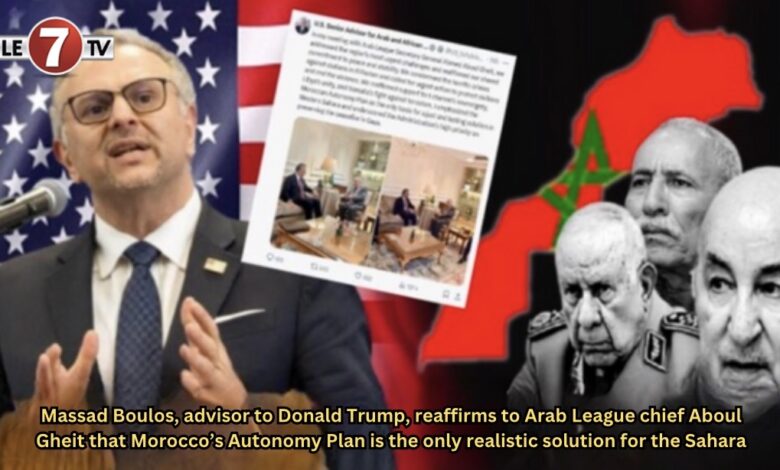
In a statement posted on his official X account, the American diplomat emphasized that “the Moroccan autonomy initiative represents the only viable framework to reach a definitive political settlement of the Sahara issue.”
This declaration reinforces the consistent U.S. position, which recognizes Morocco’s full sovereignty over its Sahara, in line with the historic decision announced by President Trump in December 2020 and reaffirmed by UN Security Council Resolution 2797, which regards the autonomy plan under Moroccan sovereignty as the sole credible and sustainable solution to this regional dispute.
Boulos also noted during an appearance on Medi1 TV and Medi1 Radio that “the American position on the Sahara issue is perfectly clear and leaves no room for ambiguity.” He added:
“This position has been expressed repeatedly, including last week by U.S. Secretary of State Marco Rubio, and it faithfully reflects the stance personally conveyed by President Trump to His Majesty King Mohammed VI, confirming the total and irreversible recognition by the United States of Morocco’s sovereignty over its Sahara.”
The U.S. advisor concluded by reaffirming Washington’s continuous support for the Moroccan Autonomy Plan, describing it as the only serious and credible solution, and denounced “rumors and unfounded interpretations” claiming otherwise, calling them “pure disinformation with no basis whatsoever.”
Translated from Abderrazzak Boussaid’s French article- le7tv