An Exceptional Partnership Between Washington and Rabat: A Strategic Meeting Between Nasser Bourita and Christopher Landau

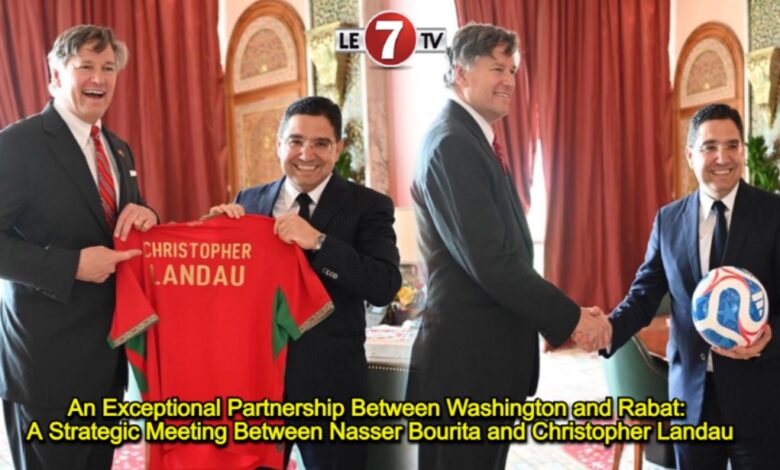
The historic and strategic relationship between Morocco and the United States was once again highlighted through a high-level meeting in Rabat. Following his discussions with Foreign Minister Nasser Bourita, U.S. Deputy Secretary of State Christopher Landau described the meeting as “excellent,” reflecting the strength of a partnership rooted in nearly 250 years of friendship.
In an official statement relayed by the U.S. Embassy in Morocco, Christopher Landau emphasized that discussions with his Moroccan counterpart covered a wide range of bilateral, regional, and global issues. He notably reaffirmed Washington’s consistent position recognizing Morocco’s sovereignty over the Western Sahara, while supporting the Kingdom’s autonomy initiative as the basis for a “just and lasting” solution.
This stance confirms the continuity of U.S. commitment to Morocco’s territorial integrity, further strengthening the international credibility of the Moroccan proposal.
The meeting also highlighted the expansion of the partnership into forward-looking sectors, particularly space. The U.S. official welcomed Morocco’s accession to the Artemis Accords, making the Kingdom the 64th signatory to this global initiative promoting responsible space exploration.
This development underscores Morocco’s growing influence in advanced technological sectors and its emergence as a credible player on the international scientific stage.
In a message also published on the platform X, Christopher Landau stressed the strength of the partnership between the two nations, highlighting shared priorities such as regional stability, economic opportunities, and people-to-people ties :
” Excellent meeting this afternoon with my friend Nasser Bourita, the highly respected and insightful Foreign Minister of Morocco. We discussed a wide range of bilateral, regional, and global issues, and I reaffirmed US recognition of Moroccan sovereignty over Western Sahara and support for Morocco’s Autonomy Proposal as the basis for a just and lasting solution. I was delighted to witness Morocco’s accession as the 64th member of the Artemis Accords, which promote responsible space exploration. Our two nations have been friends for almost 250 years, and I’m honored to reaffirm that friendship here in Morocco”
Through this visit and the accompanying official statements, Morocco reaffirms its status as a major U.S. ally in Africa and the Arab world. With political alignment, security cooperation, and openness to future technologies, Rabat and Washington continue to build an exemplary partnership—strong, ambitious, and firmly oriented toward the future.
Abderrazzak Boussaid / Le7tv