Laâyoune: The Royal Atlantic Initiative at the Heart of an Academic Forum on South-South Cooperation
The Royal Atlantic Initiative was at the center of discussions during the 7th edition of the International Scientific Forum, which opened Thursday in Laâyoune, with the ambition of consolidating Morocco’s role as a strategic platform for South-South cooperation.

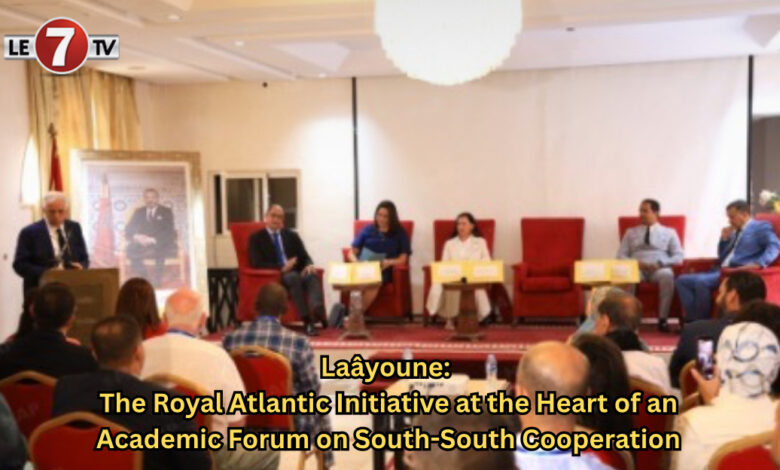
Organized by the Al Andalous Institute of Saharan Studies, in partnership with the Faculty of Legal and Political Sciences of Fez and the Mexican Observatory of the Moroccan Sahara, and with the support of the Ministry in charge of Relations with Parliament and the Laâyoune-Sakia El Hamra region, this event brought together researchers, academics and experts from Africa, Latin America, Spain and Morocco.
The meeting took place in a context marked by the redefinition of geopolitical balances and the need for a new shared narrative. For participants, South-South cooperation can no longer remain a matter of principle; it must translate into concrete, structuring and sustainable projects, in line with the Initiative launched by His Majesty King Mohammed VI, aimed at facilitating access for Sahel countries to the Atlantic Ocean.
In his address, Mohammed Senoussi, President of the Moroccan Council on Foreign Affairs, stressed that “the Royal Atlantic Initiative has the potential to create a new dynamic, making Morocco a central actor of the Global South.”
“This Initiative represents a strategic lever for the entire African continent, which aspires to free itself from the constraints inherited from the past,” he added.
For his part, Bachir Edkhil, President of the Al Andalous Institute of Saharan Studies, noted that this forum “highlights the strategic scope of the Royal Atlantic Initiative, which lays the foundations for an innovative South-South partnership based on common interest, complementarity and mutual development.”
Guided by the Royal Vision, the forum aims to establish a unifying intellectual and scientific platform through intercontinental dialogue, academic diplomacy and the promotion of the cultural heritage of the Moroccan Sahara, he stated.
Discussions focused on several key themes, including development dynamics in the Southern Provinces, opportunities offered by major infrastructure such as the Port of Dakhla or the Nigeria-Morocco gas pipeline, and prospects for academic and cultural cooperation between both shores of the Atlantic.
For Spanish academic Rafael Esparza Machin, “the Royal Atlantic Initiative is essential to strengthen Morocco’s openness to its regional and continental environment, particularly in an increasingly multipolar world.” He also highlighted the Kingdom’s role in creating synergies among African countries through large-scale integration projects.
Similarly, Jawad Snoussi, professor at the National University of Mexico, expressed his hope to “forge concrete ties between Mexican, Moroccan and African universities in the fields of scientific research, cultural cooperation and training.”
In the same spirit, Reyna Carretero Rangel, President of the Mexican Observatory of the Moroccan Sahara, described this forum as “the culmination of a scientific effort launched eight years ago, built on trust, exchanges and the co-construction of a shared reflection between both shores.”
The event was also marked by the presentation of six academic works on South-South cooperation, written by researchers from the participating regions.
Participants stressed the need to establish a shared roadmap founded on intercontinental solidarity and humanist principles, in order to make the Atlantic space a lever of convergence.
Editorial team/le7tv