Morocco Becomes the “World Capital of Parliamentary Diplomacy,” Say Presidents of Four Latin American Regional Parliaments
On Sunday in Lima, the presidents of four regional parliaments from Latin America and the Caribbean declared that Morocco has become the “world capital of parliamentary diplomacy.”


Morocco Becomes the “World Capital of Parliamentary Diplomacy,” Say Presidents of Four Latin American Regional Parliaments
On Sunday in Lima, the presidents of four regional parliaments from Latin America and the Caribbean declared that Morocco has become the “world capital of parliamentary diplomacy.”
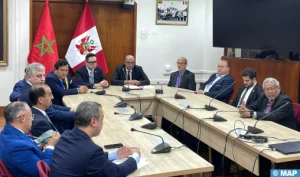
During a meeting with a delegation from the House of Councillors, led by its President Mr. Mohamed Ould Errachid, on the sidelines of the 16th Euro-Latin American Parliamentary Assembly (EuroLat), the presidents of these regional parliaments expressed a strong desire to strengthen cooperation with the Moroccan Parliament.
They also highlighted the importance of the recently established Morocco–Latin America Parliamentary Economic Forum, calling for seizing opportunities to promote economic and political relations between the Kingdom and the Latin American region.
The meeting took place at the Peruvian Congress and brought together the Moroccan delegation with:
- Gustavo Pacheco Villar, President of the Union of Latin American and Caribbean Parliaments (UPLAC) and President of the Andean Parliament
- Rolando Patricio González, President of the Latin American and Caribbean Parliament (Parlatino)
- Carlos Hernandez, President of the Central American Parliament (Parlacen)
- Nicolás Viera, Vice-President of the Parliament of MERCOSUR (Parlasur)
Speaking on behalf of the Latin American regional parliaments, Rolando Patricio González recalled the joint declaration signed in December, which established a permanent parliamentary economic forum between Latin America and Morocco. He expressed his conviction that this forum would yield mutually beneficial outcomes for all parties involved.
During Sunday’s working session in Lima, the four Latin American parliamentary groups and the Moroccan delegation discussed ways to deepen parliamentary ties and enhance exchanges of experience and expertise.
Mr. Mohamed Ould Errachid reviewed the numerous parliamentary meetings previously held in Morocco—notably the Marrakech Parliamentary Economic Forum and the South-South Parliamentary Dialogue Forum—with active participation from Latin American regional parliaments.
He emphasized that the relationship between Moroccan and Latin American parliamentarians is founded on mutual trust and an unwavering belief in the importance of parliamentary diplomacy. This has led to the creation of both the Morocco–Latin America Parliamentary Economic Forum and the Afro-Latin American Parliamentary Dialogue (AfroLac).
Sunday’s meeting in Lima, Ould Errachid added, was “not an isolated event but a new milestone in building interregional dialogue,” particularly in its Afro–Latin American and Arab–Latin American dimensions.
He further stressed that South–South cooperation is a cornerstone of Moroccan diplomacy, guided by His Majesty King Mohammed VI, and rooted in the values of solidarity, dialogue, and mutual respect shared by the Moroccan people.
The House of Councillors delegation is in Lima to participate in the 16th Euro-Latin American Parliamentary Assembly, held from June 1st to 3rd.
The working session with the presidents of the four Latin American parliaments was also attended by Mr. Amin Chaoudri, Morocco’s Ambassador to Peru.
Editorial team/le7tv