Tangier Hosts the 6th Annual Retreat of the Forum of African Diplomats in Addis Ababa
The 6th Annual Retreat of the Forum of African Diplomats in Addis Ababa (FADA) opened on Monday in Tangier under the theme “The African Union: Strategic Positioning in a Changing Global System.”

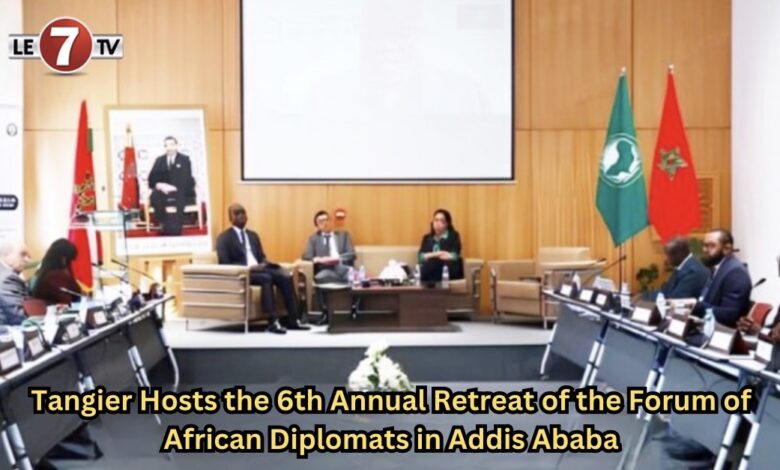
Organized by the Institute for Security Studies (ISS), in collaboration with the Ministry of Foreign Affairs, African Cooperation and Moroccan Expatriates, and the FADA, the event offers a high-level platform for in-depth reflection on the institutional, operational, and strategic profile of the African Union (AU). Its goal is to help the AU effectively address both internal and external challenges while ensuring Africa’s optimal positioning within a rapidly evolving global order.
This Retreat aims to deepen reflection on the strategic implications of global geopolitical shifts for Africa’s economic, political, and security agendas, while identifying the institutional, operational, and governance reforms needed to strengthen the AU’s role and enable it to respond proactively to these changes.
Speaking on this occasion, Hassane Boukili, Director of the African Union and African Regional Organizations Division at the Ministry of Foreign Affairs, African Cooperation and Moroccan Expatriates, highlighted the importance of the Retreat’s theme, which calls upon all the living forces of the Continent and reminds every African actor of their duty and responsibility toward Africa. He stressed the need to renew adherence to African values and pan-African strategic objectives to better serve peace, security, and co-development across the continent.
Mr. Boukili underlined the imperative of adopting a renewed form of pan-Africanism—one that looks to the future and responds concretely to the expectations of African youth, free from the false problems that have long hindered the Continent’s focus on its true shared priorities. This renewed vision, he said, would strengthen Africa’s economic competitiveness and its political leadership within the UN, the G20, and in its relations with global partners now turning their attention to Africa.
He recalled that Morocco, under the leadership of His Majesty King Mohammed VI, may God Assist Him, reaffirmed its commitment during the Kingdom’s return to the African Union in 2017 to contribute meaningfully to Africa’s leadership emergence. This commitment, he added, has been demonstrated through numerous initiatives addressing continental challenges such as terrorism, health and food security, climate change through the “Triple A” Initiative launched at the Marrakech Action Summit in 2016, connectivity through the Atlantic Initiative aimed at opening access for Sahel countries, and migration based on the peace-security-development nexus.
“The AU must complete its institutional reforms, refocus its agenda on shared strategic priorities, modernize its working methods, and rationalize the use of its financial and human resources to achieve higher levels of performance and professionalism,” Mr. Boukili emphasized. He also invited participants to examine the issue of AU financing and reflect on the most appropriate means and initiatives to allow the organization to fully own its peace, security, development, and governance policies—so as to ensure a stronger African voice on the global stage.
For her part, former Minister of National Land Use Planning, Urban Planning, Housing, and City Policy, Nouzha Bouchareb, noted that this Retreat, which has over the years become a high-level space for reflection, testifies to the vitality of African cooperation and the shared will to build a more integrated, resilient, and influential Africa.
She stated that a strong African leadership supported by proactive and coherent diplomacy is now a major strategic asset for advancing African interests in global decision-making, transforming geopolitical crises into opportunities for growth and sustainable development, and reinforcing the continent’s sovereignty, resilience, and influence on the international scene.
Ms. Bouchareb added that Morocco, guided by the enlightened vision of His Majesty the King, plays a catalytic and leadership role within this continental dynamic, consistently working for African unity and collective interest. She explained that the Kingdom places diplomacy at the service of Africa’s prosperity and security by amplifying Africa’s voice in international forums, mobilizing development and resilience financing, and supporting peace, security, and regional stability.
For his part, Moussa Soumahoro, Regional Director of the ISS for Eastern Africa and Permanent Representative to the AU, emphasized that this event takes place in a complex global context marked by rapidly shifting geopolitical balances, intensified rivalries among major powers, reconfigured economic and value chains, as well as persistent security pressures and governance challenges. He noted that African countries and their regional organizations, particularly the AU, are seeking ways to achieve greater strategic autonomy.
In a video message, Mr. Soumahoro stressed that this Retreat provides a privileged space for consultation and forward-looking dialogue, bringing together diplomats and experts to reflect on Africa’s strategic positioning in a transforming international system, analyze vulnerabilities, identify levers for action, and formulate concrete responses to the challenges facing the continent. He expressed ISS’s gratitude to Morocco for its support in hosting the Retreat in Tangier, which reflects the Kingdom’s steadfast pan-African commitment and its vision of an active, united, and sovereign Africa.
Franck Adiko, President of the Forum of African Diplomats in Addis Ababa, welcomed the organization of such a major event in Morocco—particularly in Tangier, a true bridge between Africa and the rest of the world. He noted that the chosen theme comes at a particularly timely moment, when Africa must assert itself as an active, emerging, and influential player on the international stage amid rapid global change and numerous continental and global challenges.
He added that this Retreat would provide an opportunity to explore multiple dimensions of Africa’s global positioning, including AU reform, the continent’s role in global peace and security, the power of diplomacy in shaping the African narrative, and more. He called on participants to engage in these exchanges with open-mindedness, creativity, and a deep sense of shared mission.
Running until November 6, the event will focus on identifying concrete measures that member states should adopt to achieve the vision of “the Africa We Want,” by promoting unity, resilience, and better integration of the continent into a constantly evolving world order.
Discussions will cover several themes, including “Analysis of Global and Continental Dynamics and Their Implications for the African Union,” “Managing the AU’s Challenges and Aspirations Amid Constraints,” “Strengthening the AU’s Engagement with Its Partners,” “Peace and Security Challenges,” and “The Role of Member States and Regional Economic Communities (RECs) in Building the Desired AU.”
Editorial team/le7tv