IAEA Chief Labels Morocco as Provider of Expertise, Scientific Solidarity
Vienna - The International Atomic Energy Agency (IAEA) Director General, Rafael Mariano Grossi, hailed Morocco as a provider of expertise and scientifique solidarity, describing it as a reference partner of the Agency.

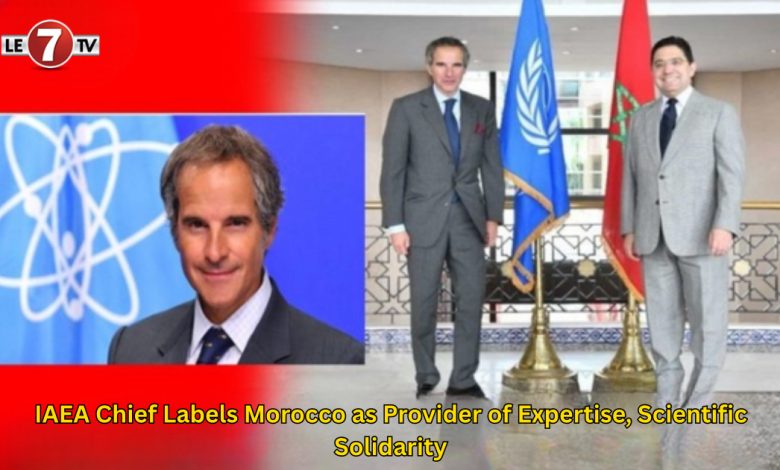
In an interview with MAP on the occasion of the 26th Throne Day celebrations, Grossi attributed this recognition to the multiple reforms undertaken under the leadership of His Majesty King Mohammed VI, a steadfast champion of South-South cooperation.
IAEA Head praised Morocco’s active and constructive role within the Agency, highlighting the country’s exemplary contribution to promoting the peaceful applications of nuclear technology both nationally and across Africa.
“Morocco is a center of excellence in Africa and a valuable cooperation channel for countries with fewer resources,” he said, emphasizing the technical and institutional support the Kingdom provides to other African member states.
He further hailed the Kingdom as “a reliable partner” and “a significant player” within the IAEA’s governing bodies, notably during its presidency of the General Conference in 2020, where it successfully acted as a facilitator of compromise.
Morocco also stands out for its “very significant” technical profile in several areas of nuclear application, including health, environment, agriculture, and potentially energy, Grossi added.
Addressing Morocco’s role as a regional hub for training and skills transfer, Grossi described the Kingdom as a pioneer in this field. He recalled the visits he made to Morocco’s National Center for Energy, Sciences and Nuclear Techniques (CNESTEN), where he witnessed many African trainees and experts.
“Morocco combines our capacities with its own, in a spirit of cooperation that perfectly reflects its Pan-African tradition of solidarity,” he said, urging against isolated projects, which Morocco “has clearly understood by acting as a platform for regional integration.”
The IAEA chief also praised Morocco’s concrete achievements within the framework of technical cooperation, notably in radiotherapy, nuclear medicine, water management, and climate-adapted agriculture.
He also cited collaboration in isotopic hydrology, a nuclear technique application that maximizes water use in agriculture as well as general water management.
Furthermore, Grossi highlighted the Kingdom’s active participation in two flagship IAEA programs: “Rays of Hope” for cancer treatment and “Atoms for Food” for developing drought-resistant crops.
When asked about Morocco’s approach to sustainable development, the IAEA chief expressed his deep appreciation for the leadership of His Majesty the King, who has always emphasized the importance of harmonious and sustainable development, the thing which aligns with the IAEA’s objectives.
Regarding health, agriculture, and scientific reforms, Grossi emphasized that this progress has been made possible thanks to a clear and sustainable development vision upheld at the highest level of the state.
Editorial team/le7tv