Ferhat Mehenni Challenges Algerian Regime by Setting December 14 as Date for Kabylie Independence Proclamation
The sandcastle built by Algeria’s military regime continues to crumble. Faced with an authoritarian power mired in contradictions and unable to ensure national cohesion, the voice of Kabylie is growing louder. Ferhat Mehenni, President of the Provisional Government of Kabylie in exile and leader of the Movement for the Self-Determination of Kabylie (MAK), has announced a decisive step: the official proclamation of Kabylie’s independence, set for December 14, 2025.

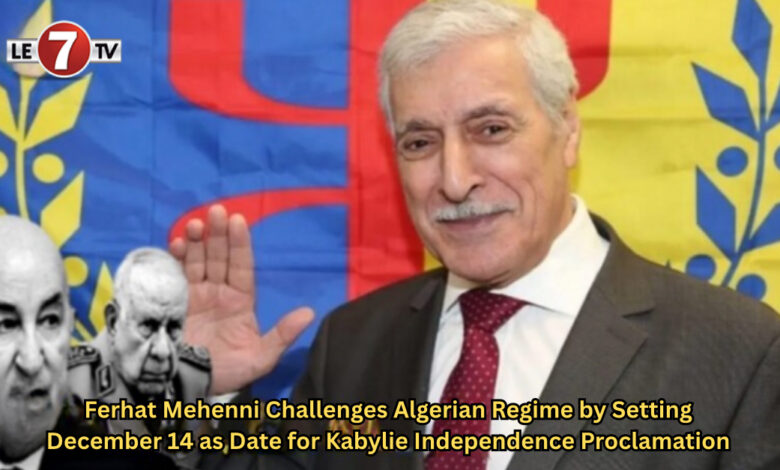
In an interview broadcast on September 7, Mehenni outlined a clear political calendar. On October 19, an extraordinary congress of the MAK will gather supporters of the movement to validate the draft unilateral declaration of independence. The text will then be submitted to the “Kabyle Parliament in exile” for adoption. The choice of December 14 is no coincidence, as it marks the anniversary of United Nations Resolution 1514 on decolonization, underlining what he describes as the obvious parallel between Kabylie’s situation and that of colonized peoples.
Ferhat Mehenni does not mince words. According to him, Kabylie has been “colonized by the Algerian state since 1962,” a state that he claims has never been anything but a machine for confiscating freedoms and crushing identities, orchestrated by a military junta deaf to popular aspirations. The regime, sustained only by repression and gas revenues, has labeled the MAK a “terrorist movement,” which Mehenni considers further proof of its panic in the face of legitimate contestation.
The MAK, born in the bloody context of the 2001 “Black Spring” — an uprising violently repressed by Algerian forces that left more than 120 dead and thousands injured — has evolved from identity-based demands into a full-fledged national liberation project. Far from fading, the movement has gained momentum despite demonization campaigns orchestrated from Algiers.
It is clear that a unilateral declaration of independence will carry symbolic weight above all in the beginning. Yet this symbol could prove to be a powerful weapon against a military dictatorship that still claims to embody “national unity” while stifling diversity and silencing its people. By framing the Kabyle issue within the context of international law and decolonization, Ferhat Mehenni forces the Algerian regime to confront its contradictions and opens a breach that even the harshest repression may not be able to close.
Kabylie, a land of history, culture and resistance, has not spoken its last word. As Algiers becomes mired in geopolitical obsessions and sterile adventures, it is its own internal fractures that risk precipitating the collapse of a system worn down to the core.
Translated from Abderrazzak Boussaid’s French article – le7tv