Minister of Health Amine Tahraoui: “The comprehensive reform project we are working to implement is the path to meeting citizens’ expectations in the health sector”
The Minister of Health and Social Protection, Amine Tahraoui, affirmed on Wednesday that the government understands the social demands expressed by young people and by citizens in general, foremost among them the reform of the health sector. He stressed that the comprehensive reform project currently being deployed is the only way to respond to these expectations.

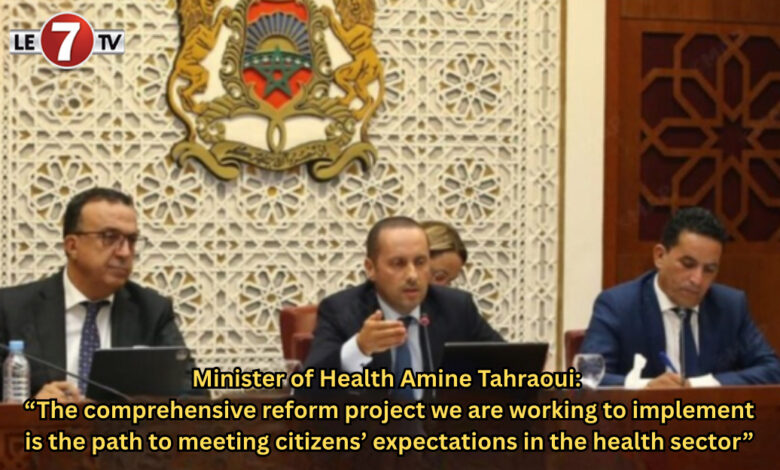
Speaking at a meeting of the Committee on Social Sectors in the House of Representatives, devoted to examining “the current state of the health system and the measures taken to accelerate its reform in order to guarantee citizens’ right to care,” Tahraoui declared:
“This comprehensive reform project that we are leading is the true lever to meet the legitimate expectations of citizens, namely access to quality health services, respectful of their dignity, and available across the entire national territory.”
The minister acknowledged that the problems in the sector are longstanding and accumulated over time, while pointing out that the government has already launched reforms, beginning with the strengthening of the legal framework, to which Parliament has made a major contribution to ensure its adoption and implementation.
Strengthening infrastructure and investments
Tahraoui highlighted the existence of a clear vision for the development of health infrastructure, recalling the significant investments made in recent years. However, he admitted that these advances, though notable, remain insufficient to address the deficits, particularly in certain provinces and regions.
He stated that the ministry is working to accelerate the construction and rehabilitation of hospitals and health centers throughout the Kingdom. Several large-scale projects have been completed, are under way, or are planned, allowing for the creation of more than 3,500 new beds, including:
- Mohammed VI University Hospital (CHU) in Tangier (797 beds),
- CHU in Agadir (867 beds),
- CHU in Laâyoune (500 beds),
- the new Ibn Sina University Hospital in Rabat (1,044 beds),
as well as CHU projects in the regions of Guelmim, Drâa-Tafilalet, and Béni Mellal.
As for primary care facilities, the minister noted that the program covers more than 1,400 health centers spread across 76 provinces. Of these, 945 have already been fully renovated, 405 are under rehabilitation, and 50 additional projects are planned.
Between 2022 and 2025, 22 hospitals have also been modernized, adding a reception capacity of 2,433 beds in different regions of the Kingdom.
Shortage of human resources and training plan
Tahraoui also acknowledged the existence of a shortage of human resources in the sector, while making clear that there is no immediate solution. Nevertheless, a long-term vision has been put in place, particularly through the creation of new faculties and institutes and the expansion of training opportunities.
Thus, the number of teaching places for medical students will rise to 6,414 in 2025, compared to 2,650 in 2019, an increase of 142%. For higher institutes of nursing and health technologies, capacity has been raised to 9,500 places in 2024, compared to 2,735 in 2019.
This momentum has been reinforced by the opening of four new faculties: medical schools in Guelmim, Béni Mellal, and Drâa-Tafilalet, as well as a faculty of medicine and pharmacy in Laâyoune, whose first graduates will complete their studies starting in 2026.
Recruitment and improvement of social conditions
The minister added that the number of health professionals has increased from 45,000 in 2019 to more than 59,000 in 2025, representing a 30% rise. The corps of nurses and health technicians grew by 29% (from 27,000 in 2019 to 35,000 in 2025), while administrative and technical staff increased by 62% over the same period.
Finally, Tahraoui recalled the efforts undertaken to improve the social and professional situation of health personnel, through progressive salary increases between January 2022 and July 2025:
- +4,390 dirhams for general practitioners and dentists,
- +4,405 dirhams for specialist doctors,
- +3,950 dirhams for nurses and technicians,
- +1,750 dirhams for administrative staff,
- +1,700 dirhams for technical auxiliaries.
Editorial team/le7tv