United Kingdom: Morocco’s Maritime Strategy in the Spotlight at the Africa Summit in London
Morocco’s ambitious maritime strategy, implemented under the leadership of His Majesty King Mohammed VI to position the Kingdom as a global hub for maritime trade and logistics, was in the spotlight at the Africa Summit, a high-level event organized on Wednesday in London by the prestigious Financial Times.

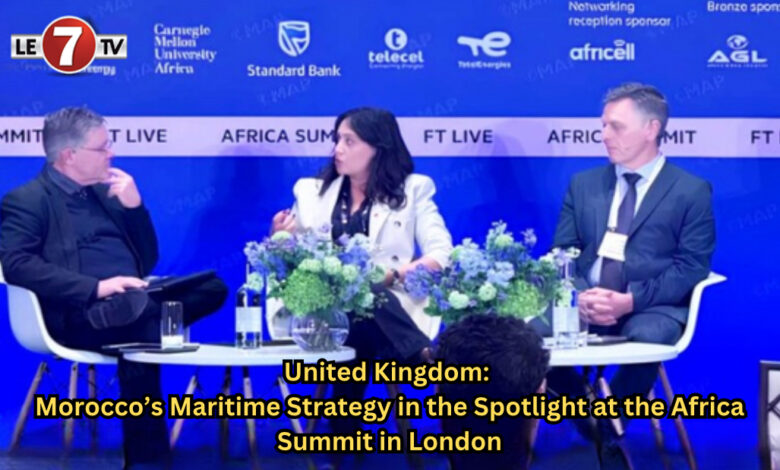
Speaking at the summit, Nisrine Louzzi, Director of Development at the Dakhla Atlantic Port, presented Morocco’s port strategy to an audience of business leaders and investors from around the world.
She emphasized that this policy is built on a clear, forward-looking vision aimed at firmly positioning Morocco as a maritime and logistics hub linking Africa, Europe, and the Americas. “Over the past two decades, Morocco has developed a coherent national port strategy that combines infrastructure development, governance modernization, and digital transformation,” she said, explaining that this approach has strengthened Morocco’s global competitiveness, attracted investment, and boosted regional integration while ensuring that port development contributes to sustainable growth and balanced territorial development.
As an example, she cited the Tangier Med Port, which has emerged as a leading hub for maritime transport and connectivity.
Louzzi also highlighted the importance of the Royal Atlantic Initiative, a cornerstone of Morocco’s blue economy and South-South cooperation.
Launched by His Majesty King Mohammed VI, this Royal Initiative embodies Morocco’s vision for a shared and prosperous Atlantic space. Louzzi noted that it connects Atlantic African states through maritime cooperation, energy connectivity, and partnerships for the blue economy.
The initiative also promotes South-South collaboration by encouraging port complementarity, joint investments in logistics corridors, and the sustainable exploitation of marine resources. She added that it represents a new model of Atlantic solidarity, where ports become platforms for exchange, innovation, and inclusive growth.
Discussing the Dakhla Atlantic Port, Louzzi explained that it stands as a catalyst for new models of development.
“The Dakhla Atlantic Port perfectly reflects Morocco’s commitment to integrating port infrastructure into its new models of territorial and economic development,” she said. Designed as a gateway between the Atlantic and the Sahel, this deep-water port will support industrial hubs, renewable energy projects, and regional trade while creating opportunities for youth and local communities. Beyond its economic purpose, Dakhla Atlantic embodies a transformative vision of development where infrastructure serves diplomacy, sustainability, and continental ambition.
The Financial Times Africa Summit serves as a unique platform for Africa’s most influential business, financial, and political leaders to meet with global investors and partners, explore new opportunities, unlock growth, and shape the next chapter of Africa’s economic story.
Several high-profile figures attended the event to examine business opportunities across various high-value sectors. The program featured panels on topics such as the future of finance in Africa, intra-African trade, strengthening continental stability, the rise of fintech, and the impact of climate change on agriculture.
Editorial team/le7tv