Rabat: Nadia Fettah Calls for Women’s Employment to Be Placed at the Heart of Economic and Political Strategies
The Minister of Economy and Finance, Nadia Fettah, called on Tuesday in Rabat for women’s employment to be placed at the core of economic and political strategies, on an equal footing with major macroeconomic balances.

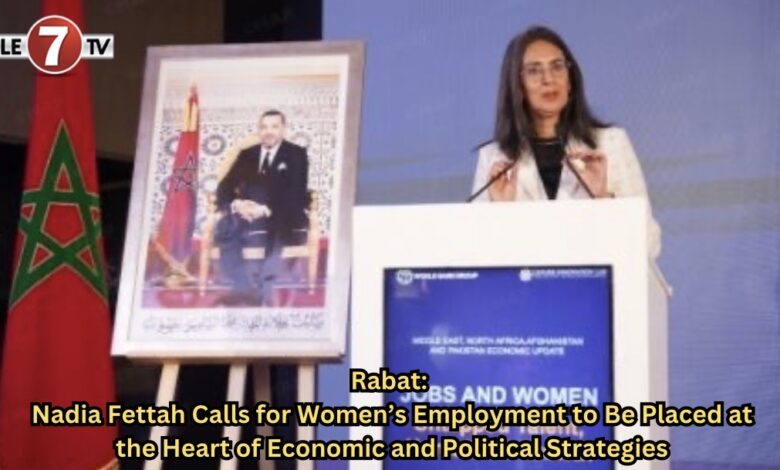
Speaking at the launch of the World Bank’s MENAAP (Middle East, North Africa, Afghanistan and Pakistan) Economic Update titled “Jobs and Women: Untapped Talent, Unrealized Growth”, Ms. Fettah reaffirmed the government’s strong commitment to this strategic issue.
The Minister drew a parallel between the four pillars of the 2025 Finance Bill and women’s employment, highlighting the Kingdom’s solid economic performance, with 4.8% growth this year and 4.6% projected for next year.
Ms. Fettah also stressed the need to intensify efforts and strengthen women’s participation in the workforce in order to meet growth objectives, adding that the ambition of achieving “One-speed Morocco” requires genuine gender equality between men and women.
She recalled the progress made in gender-sensitive public policies, particularly through the Gender-Responsive Budget, financial inclusion strategies, and preschool development programs.
For her part, Roberta Gatti, Chief Economist for the MENAAP region at the World Bank, presented the findings of the regional report, noting that the region is expected to achieve 2.8% growth in 2025, up from 2.3% in 2024. This increase is largely driven by developing oil-importing countries, including Morocco, which are benefiting from lower inflation, higher consumption and investment, and a better agricultural season.
Ms. Gatti emphasized that the region faces a major demographic challenge, with a 40% increase in the working-age population by 2050, alongside a rapid decline in fertility rates, which could put pressure on health and pension systems.
In this context, she stated that increasing women’s participation in the labor market represents a natural and strategic solution for the region. She pointed out that several countries have made significant progress in this area, citing Saudi Arabia, Pakistan, and Tunisia, and noted that Morocco stands out among the few countries in the region with strong performance in the World Bank’s “Women, Business and the Law” index, particularly in terms of its legal framework.
Quoting the report, she affirmed that removing barriers to women’s economic participation could raise GDP per capita by 20 to 30% in regional economies. She called for a comprehensive approach combining improved childcare services, flexible work arrangements, private sector dynamism to create more jobs, and bold legal reforms in parental rights and pension equity.
Also speaking at the event, Dr. Mary Kawar, Director of the UNDP Regional Bureau for Arab States, underlined the importance of a holistic approach that enables women not only to find jobs but also to retain them. She stressed the need to address structural barriers related to family policies, infrastructure, transport, and childcare.
She shared Jordan’s experience in reforming maternity leave, explaining that it took a decade of collaborative work involving the government, parliament, and civil society to adopt a functional law in 2020, which has since expanded to include paternity leave and childcare vouchers.
Dr. Kawar emphasized that sustainable development requires “a vision and political will, multiple interventions carried out simultaneously and coherently over a very long period of time.”
This event, marking the first time the World Bank has launched its flagship regional economic report from within the MENAAP region, brought together high-level representatives from Morocco and beyond, including public institutions, the private sector, academia, and civil society. It reflected a shared commitment to empowering women’s human capital as a strategic driver of growth and prosperity.
Editorial team/le7tv