Dakhla: Leila Benali says the Atlantic Sahara will become “a strategic corridor of connectivity and regional integration for the continent”
The Minister of Energy Transition and Sustainable Development, Leila Benali, stated on Friday in Dakhla that the Atlantic Sahara is set to become “a strategic corridor of connectivity and regional integration between two continents,” thanks to visionary large-scale energy projects launched under the leadership of His Majesty King Mohammed VI.

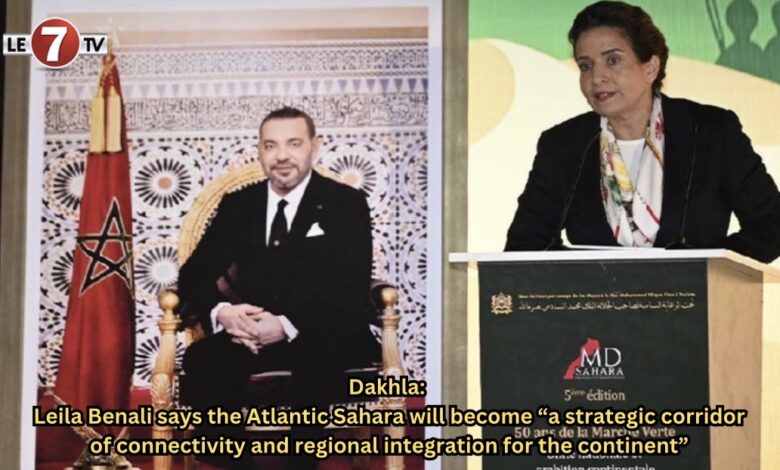
Speaking during a keynote address at the MD Sahara Forum, held under the theme “The Atlantic Sahara, a corridor of connectivity and regional integration between two continents,” Ms. Benali announced that Morocco is “on the verge of officially launching its sovereign gas infrastructure.” This infrastructure includes the gas import terminal of Nador West Med, as well as pipelines designed to link the northern and central regions of the country (Tangier, Kenitra, Mohammedia) to major industrial and energy hubs.
The minister noted that this infrastructure will be connected to the first phase of the Africa–Atlantic gas pipeline, formerly known as the Nigeria–Morocco Gas Pipeline, renamed last December by joint decision of the African ministers involved.
“This pipeline is not just a pipe: it is an instrument of economic and social integration between North Africa and West Africa, and a lever for regional connectivity,” she said.
She also highlighted progress on the Morocco-Mauritania electrical interconnection, which will support supply security, electricity exchange and the establishment of a structured regional energy market along the Atlantic corridor.
This dynamic effort complements the reinforcement of the Morocco–Spain, Morocco–Portugal and Morocco–France interconnections and the future North–South high-voltage direct current HVDC lines, positioning the Kingdom as a “true energy corridor between Africa and Europe.”
Ms. Benali also recalled the strategic role of the OTC corridor (Origination, Transit and Certification), which will be officially announced on November 24 during the International Mining Congress of Morocco.
Speaking on the energy potential of Morocco’s southern provinces, the minister emphasized that they already host more than 1.5 GW of installed renewable energy capacity, representing an investment exceeding 20 billion dirhams.
The current plan foresees an additional 1.5 GW by 2030, requiring the construction in less than five years of more capacity than what has been deployed over the last two decades, she added.
The Moroccan Sahara, Ms. Benali concluded, will fully reclaim its historical role as “a crossroads of connectivity and exchange between North and South, from Tangier to Port Harcourt, in service of shared and sustainable development.”
The 5th edition of the annual MD Sahara Forum opened Friday in Dakhla under the theme “50 Years of the Green March: National Unity and Continental Ambition.”
Held under the High Patronage of His Majesty King Mohammed VI, the forum, organized by the Morocco Diplomatique media group, highlights the historic and political legacy of the Green March and its continuation in Morocco’s contemporary strategies, particularly its leadership in regional integration and African cooperation.
The event brings together government officials, economic actors, academics and representatives of regional and international organizations for two days of discussion and exchange.
Editorial team/le7tv