Moroccan Sahara: A Roundtable Highlights Major Gains Achieved Through a Calm and Effective Royal Diplomacy
Morocco has achieved major advances in defending its territorial integrity thanks to a calm and effective Royal diplomacy that has strengthened the Kingdom’s sovereignty over its southern provinces, participants said on Wednesday in Rabat during a roundtable on the latest developments of the Moroccan Sahara issue in light of Resolution 2797.

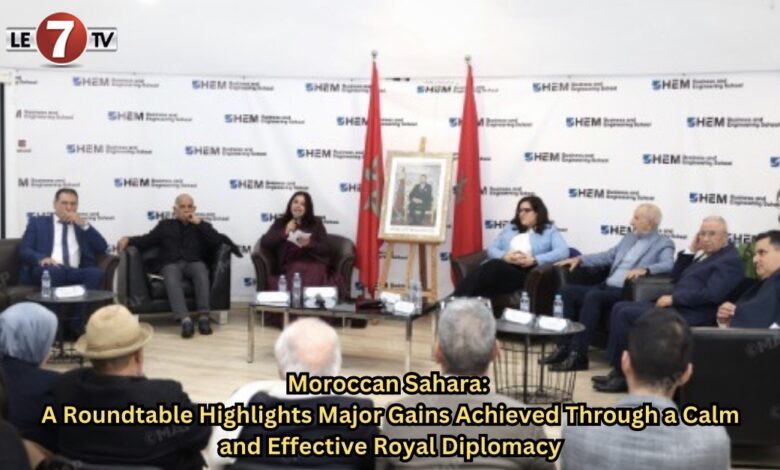
Organized by HEM Business School, the event offered an opportunity to recall that the Moroccan Autonomy Plan represents a realistic and pragmatic solution for the definitive settlement of this artificial conflict and for reinforcing Morocco’s standing at the regional and international levels.
Former minister and former Speaker of the House of Councillors, Mohamed Cheikh Biadillah, underlined that Royal diplomacy is marked by serenity and continuity. He recalled the visits of His Majesty King Mohammed VI to several African countries, the Kingdom’s return to the African Union, and its outreach to Latin American countries, all of which helped mobilize international support for the national cause. He added that progress in human rights, the improvement of women’s conditions and the adoption of the 2011 Constitution have reinforced Morocco’s role as a key player on the global stage, noting that the southern provinces have experienced major development transformations.
Former ambassador Hassan Abdelkhalek stated that the United States recognition of Morocco’s sovereignty over its southern provinces was a turning point that strengthened the momentum behind the Moroccan Autonomy Plan. He said that recent UN resolutions, particularly Resolution 2797, reinforce Morocco’s position and consolidate the path toward a political solution based on Moroccan sovereignty. He added that Morocco has consistently upheld a policy of openness, recalling the calls of His Majesty the King to Algeria to launch a sincere and fraternal dialogue aimed at overcoming differences and opening a new chapter in relations between the two countries.
Salma Benaziz, Chair of the Committee on Foreign Affairs, National Defense, Islamic Affairs and Moroccans Living Abroad in the House of Representatives, stressed that implementing the Moroccan Autonomy Plan requires broad participation from political parties, Parliament, civil society, researchers and youth. She noted that the current phase is not the end of the process, but the beginning of the consolidation of achievements and the strengthening of international recognition of the Moroccan initiative as the definitive framework for resolving the artificial regional conflict. She pointed out that the Royal Speech of October 31 marked a decisive moment, adding that Moroccan diplomacy has succeeded, alongside UN developments, in mobilizing wide international support for the autonomy plan, which reflects growing global consensus on its relevance as a final solution.
Political analyst Tajeddine El Houssaini stated that Resolution 2797 is a true turning point not only at the national level, but also regionally and continentally. He said Morocco has entered a new phase marked by the consolidation of its uncontested sovereignty over its southern provinces. He added that Moroccan diplomacy has experienced remarkable growth in recent years thanks to Royal initiatives, leading to high-level strategic agreements that reflect increasing confidence in the Kingdom’s regional and international role. He highlighted the strategic importance of building the Grand Maghreb, which would strengthen the region’s economic weight in Africa and on the international stage.
Political analyst Samir Bennis said the Moroccan Autonomy Plan is the only realistic basis for any political solution to the Moroccan Sahara issue. He emphasized that Security Council resolutions have consistently strengthened the Moroccan position, whether by praising the serious and credible efforts of the Kingdom or by considering Algeria a main party to the conflict, which marked a major shift in the dossier.
International relations expert Lahcen Aqartit explained that Morocco now sits at the heart of global political and economic geography, especially with the launch of large-scale strategic projects. He noted that Resolution 2797 consolidates Morocco’s international legitimacy in its southern provinces within a strategic context that extends from North and West Africa to Europe and includes major economic and logistical projects.
Editorial team/le7tv