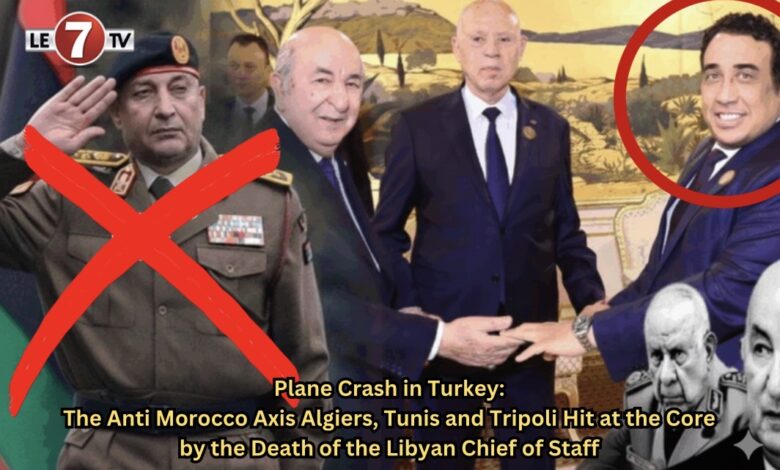
Plane Crash in Turkey: The Anti Morocco Axis Algiers, Tunis and Tripoli Hit at the Core by the Death of the Libyan Chief of Staff
The sudden death of Libya’s Chief of Staff, General Muhammad Ali Ahmed Al Haddad, along with several senior officers of the army of the Tripoli based provisional government, in an air crash in Turkey goes far beyond a tragic accident. It once again highlights the fragility of a political and military axis hostile to Morocco, built on unstable balances and backed in large part by the Algerian military regime, which now finds itself among the biggest losers.

The private Falcon 50 aircraft carrying General Al Haddad and several Libyan military officials crashed shortly after taking off from Ankara, where the delegation had been on an official mission. According to Turkish authorities, contact with the plane was lost less than forty minutes after departure, before the wreckage was located in the Haymana district south of the Turkish capital. On board were, among others, the Chief of Staff of the Ground Forces, the Director of the Military Industries Authority, and an adviser to the Chief of Staff.
In Tripoli, Prime Minister Abdelhamid Dbeibah described the incident as “a great loss for the nation,” declaring three days of national mourning and announcing the dispatch of an official delegation to Turkey to investigate the circumstances of the crash. But beyond the official statements and formal tributes, the tragedy reveals a harsher political reality: the gradual erosion of Algeria’s regional influence and the weakening of its military proxies in Libya.
General Al Haddad was not just another officer. Appointed in 2020 and originally from Misrata, he embodied the military backbone of the Tripoli camp, an objective ally of Algiers in its strategy of regional projection and indirect confrontation with Morocco. His death, alongside several key figures of the Libyan security apparatus, deals a serious blow to this already fragile structure.
For the Algerian military regime, which has stubbornly supported artificial balances in Libya, this loss sounds like a new strategic failure. After Algiers’ growing diplomatic isolation in Africa, the marginalization of its positions on the Moroccan Sahara issue, and the erosion of its traditional alliances, one of its main regional military partners has now been abruptly decapitated.
Translated from Abderrazzak Boussaid’s French article – le7tv