Morocco Now Asserts Itself as an Undisputed Emerging Power
The emergence of a power is not proclaimed, it is built. And for several years now, Morocco has been moving forward with a method that owes nothing to chance. Like Turkey in the 1990s, the Kingdom is following a path of gradual rise in power, based on a clear reading of international power relations and on a strategy of anticipation that could, by 2035, reshape regional balances.

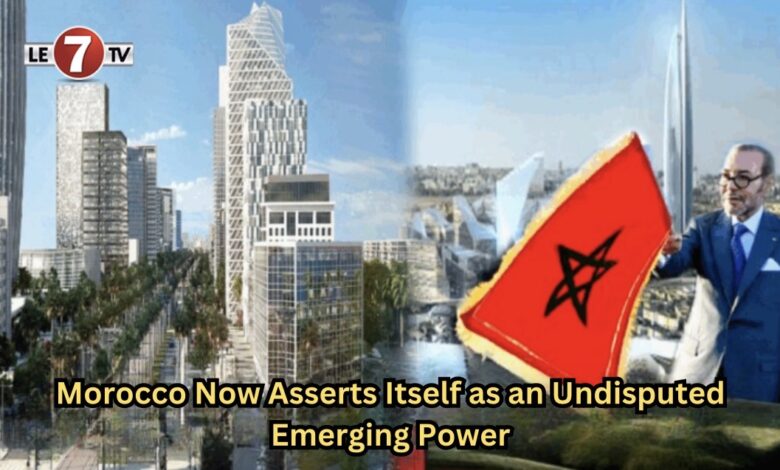
In an unstable geopolitical environment marked by the weakening of certain states, the militarization of rivalries and the reconfiguration of global value chains, Morocco has made a clear choice: that of active stability and strategic sovereignty. Unlike opportunistic powers, Rabat favors patient construction, built around strong institutions, a long term monarchical vision and a coherent diplomatic positioning.
The first pillar of this strategy is geographical. At the crossroads of Europe, Africa and the Atlantic, Morocco is turning its position into a lever of power. Major ports, logistical corridors, integrated industrial zones and future Atlantic infrastructures are not simply a development policy. They reflect a determination to establish the Kingdom as a central player in Euro African and Atlantic trade at a time when Africa is once again becoming a major field of global competition.
The second pillar is industrial and technological. Morocco no longer merely attracts investment, it selects its partnerships. Automotive, aeronautics, defense, renewable energies, semiconductors and green hydrogen. Each sector follows a sovereignty driven logic. Like Turkey, which in three decades built a defense industry capable of competing on export markets, Morocco is laying the foundations of strategic autonomy that reduces its vulnerability and strengthens its international credibility.
On the security front, the Kingdom has established itself as a regional stability actor. Its expertise in counterterrorism, border security and intelligence is now sought by many Western and African partners. This security credibility, supported by the continuous modernization of the Royal Armed Forces, gives Morocco the status of a strategic partner, far removed from the ideological posturing or risky military adventures seen elsewhere in the region.
Moroccan diplomacy is the third pillar of this rise in power. Multidimensional, pragmatic and confident, it is built on a network of diversified alliances with the United States, the European Union, Sub Saharan Africa, the Gulf countries and emerging Asia. Rabat does not align, it balances. This ability to engage with all sides while firmly defending its vital interests, starting with the Sahara issue, reflects a level of geopolitical maturity that is rare in the Global South.
Finally, the human factor remains central. Investment in skills, engineering, military and civilian training, and attractiveness for African and international talent recalls the bet made by Turkey at the end of the twentieth century: turning a large youth population into a driver of power. Morocco appears to have learned from that experience while adding a major asset, institutional continuity.
By 2035, Morocco could thus establish itself as a regional balancing power, capable of influencing security, economic and diplomatic dynamics in North Africa, the Sahel and the Atlantic space. A trajectory that stands in contrast to models based on rent, confrontation or isolation.
Like Turkey in the 1990s, Morocco is not making noise. It is moving forward. And in a global order being reshaped, that strategic discretion could well be its greatest strength.
Translated from Abderrazzak Boussaid’s French article – le7tv