Colloquium in Abu Dhabi: The values and principles that formed the foundation of Moroccan Emirati relations highlighted
Speakers at a colloquium organised on Wednesday in Abu Dhabi highlighted the values and principles that formed the foundation for the building of the strategic relations between Morocco and the United Arab Emirates during the era of the late His Majesty King Hassan II and the late Sheikh Zayed bin Sultan Al Nahyan, while also reviewing the various aspects of the development and consolidation of these ties under the enlightened leadership of His Majesty King Mohammed VI and His Highness Sheikh Mohammed bin Zayed Al Nahyan.

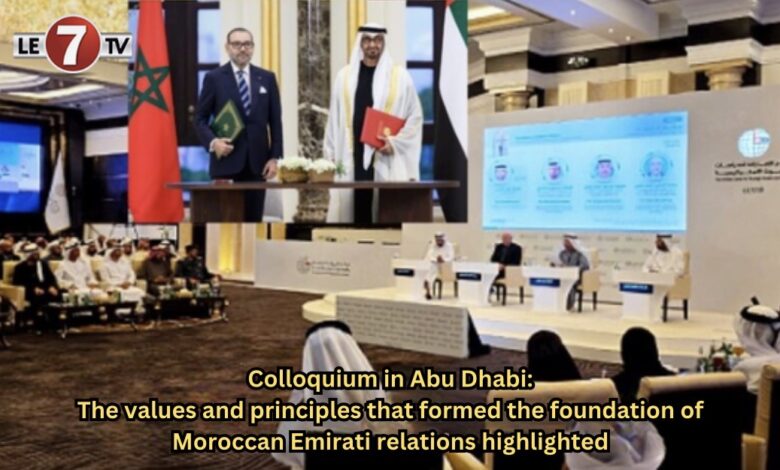
During this meeting, initiated by the Emirates Center for Strategic Studies and Research and focused on inspiration drawn from the collective book “Wisdom: visions and models in development and institution building”, in the presence of a gathering of academics, thinkers and researchers, led by Mrs Noura Al Kaabi, Minister of State at the Emirati Ministry of Foreign Affairs, the speakers stressed that this scientific book traces the course of Moroccan Emirati relations through several dimensions and aspects that highlight the uniqueness of public programmes and initiatives in the two countries.
In this context, the Ambassador of Morocco to the United Arab Emirates, Ahmed Tazi, indicated that the two countries share four main common pillars. The first concerns “citizenship and identity”, through the sharing of visions and public policies stemming from the fundamental principles of coexistence and of a citizenship capable of producing cohesion between leadership and the people, shaping identity and promoting human rights. The second is linked to the “two constitutional experiences”, by ensuring respect for the constitutional specificities of each of the two countries and by ensuring that the essential goal remains the strengthening of experiences and milestones that contribute to rooting a culture of responsibility and accountability, as well as the continuous process of building and developing the human being.
The two brotherly countries also share the principles of “independence and sovereignty”, having succeeded in forging their positions on regional and international issues based on their independence, freedom of decision and sovereignty, as well as the values of “support for peace and the concept of joint cooperation”, through their ability to place their foreign policy at the service of the objectives of their development programmes and the promotion of international peace and security. Mr Tazi also stressed that Morocco and the United Arab Emirates share a common destiny, which makes them a distinguished model of joint Arab action, while opening new prospects for the exchange of viewpoints and the strengthening of the role of thought in the face of the growing challenges confronting the Arab scene.
For his part, the Secretary General of the World Council of Muslim Communities, Mohammed Bechari, affirmed that the Moroccan Emirati experience tends to highlight what can be described as the “scientific wager” carried by the book, namely how to make wisdom a concept that produces knowledge through three paths. These are wisdom as a paradigm of governance and development, its materialisation in the models of two states, Morocco and the Emirates, as a “field of experimentation” and not merely a “success story”, and its ability to be transformed into a research programme in the fields of public policies, institution building and foresight.
The book does not limit itself to recounting the history of Moroccan Emirati relations or to highlighting the convergence of visions between Rabat and Abu Dhabi, but opens a deeper horizon by raising the question of transforming political partnerships into a productive cognitive field, and of how bilateral relations can become a laboratory for the issues of development, stability and institution building, he explained, adding that the scientific value of this approach lies in conceiving the partnership as an exchange of expertise, a transfer of know how, a building of economic trust and an expansion of research perspectives.
For his part, the Director of Libraries at Mohammed bin Zayed University for the Humanities, Abdelaziz Al Maamari, noted that this book, whose importance fits within a tense global and regional context marked by the intensification of challenges related to stability, development and identity, is not merely an academic work, but a serious intellectual attempt to rehabilitate the concept of “wise leadership” as a decisive factor in the sustainability and stability of states.
Stressing that the book “provides an answer to a fundamental question: how can nation states preserve their cohesion, achieve development and manage internal and external balances in an unstable and changing world?”, he specified that it is a collective analytical research project with multiple perspectives, the result of a structured institutional reflection based on the conviction that “states are not governed by slogans and are not built through reaction, but require a guiding wisdom capable of being translated into an institutional approach”.
It should be noted that this collective book, published in its second edition in 2025, includes five chapters spread over 437 pages. It is the result of scientific cooperation between the Royal Institute for Strategic Studies and the Office of the Vice President of the Board of Trustees of the Emirates Center for Strategic Studies and Research.
The book, which brings together the contributions of a group of Moroccan and Emirati thinkers, researchers and academics, also addresses convergences in foreign policy and the concept of bilateral cooperation in decision making, while highlighting the political significance of the opening by the United Arab Emirates of their consulate in the Moroccan city of Laayoune as a symbol of the depth of relations between Rabat and Abu Dhabi.
Editorial team/le7tv