Bordeaux: Conference on Sports Diplomacy Highlights Morocco’s Role in CAN 2025
In celebration of the Africa Cup of Nations (CAN) held in Morocco, a conference-debate on Sports Diplomacy was recently organized in Bordeaux by the Moroccan Consulate General, in partnership with the Nouvelle-Aquitaine Regional Council.

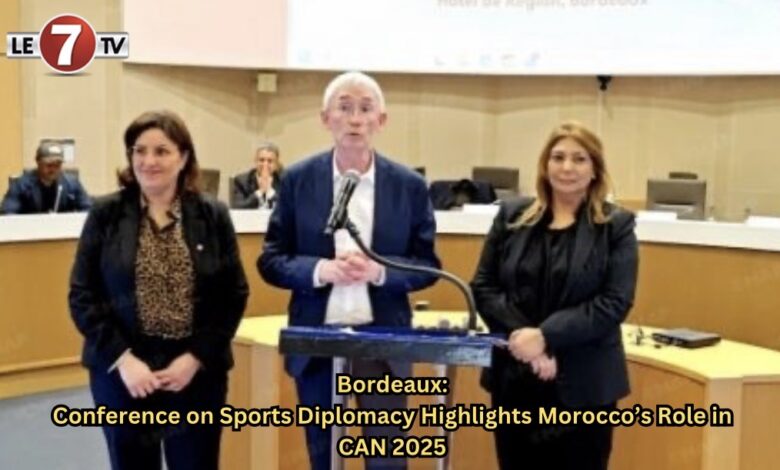
The event aimed in particular to highlight “Morocco as host of a modern, ambitious, and well-structured CAN, the strategic role of sport as a tool of soft power, international influence, and territorial cooperation,” while presenting the progress made by the Kingdom in sports, both in terms of infrastructure and governance.
The conference brought together local elected officials, institutional representatives, members of associations, diaspora communities, and personalities from diplomatic, sports, cultural, and media circles. The discussions were structured around two roundtables. The first, titled “Sport as a Tool of Soft Power and International Influence,” focused on CAN 2025 as a structuring project demonstrating Morocco’s organizational capacities and sports diplomacy, guided by an ambitious continental vision under the wise leadership of His Majesty King Mohammed VI.
The second roundtable, under the theme “Sport, Youth, and Sustainable Development,” highlighted sport’s contribution to social cohesion, inclusion, education, job creation, and the role of youth and diasporas in regional development.
“The Africa Cup of Nations 2025 in Morocco is a structuring event, far beyond just sport. It reflects the Kingdom’s organizational capacities, the quality of its infrastructure, but above all a strategic vision led by His Majesty King Mohammed VI, based on South-South cooperation and continental solidarity,” said Nouzha Sahel, Moroccan Consul General in Bordeaux.
She added, “Morocco’s sports diplomacy, also as co-host of the 2030 World Cup alongside Spain and Portugal, is part of a vision where sport becomes a tool of soft power, rapprochement, intercultural dialogue, and international influence. Sport is also a powerful lever for territorial development. It contributes to social cohesion, inclusion, youth education, job creation, and local economic dynamism, supports talent development, strengthens a sense of belonging, and participates in the transition toward sustainable and equitable development.”
Alain Rousset, President of the Nouvelle-Aquitaine Regional Council, noted that his region maintains “a longstanding relationship with the Kingdom based on territorial cooperation and experience sharing,” particularly with the Souss-Massa region.
“Through this conference on sports diplomacy, we wanted to create a shared space for reflection on the role of sport as a lever for development and influence, capable of promoting exchanges among youth and strengthening institutional cooperation,” he added.
The French official also emphasized that “Nouvelle-Aquitaine, with its expertise in sport, education, youth, and international cooperation, is committed to developing partnerships with Morocco, particularly for major sporting events such as the Africa Cup of Nations organized by the Kingdom, which structure territories and leave a tangible legacy.”
He added that the region is “proud to participate in this initiative alongside the Moroccan Consulate General in Bordeaux, in a spirit of open and forward-looking cooperation.”
Fatima Boussala Idrissi, Vice President of MeM by CGEM and CEO of Emberton Group and Sportslify, highlighted Morocco’s strategic vision in the sector, noting that the Kingdom is now establishing itself as an African hub for the sports economy.
She added that the Moroccan diaspora, entrepreneurship support mechanisms, and local incubators and accelerators are key levers to build “a sustainable, innovative sports ecosystem oriented toward Africa.”
Moncif Lyazghi, a university researcher specializing in sports policies, stated that “the structuring projects launched within the framework of CAN 2025 and the 2030 World Cup have significantly strengthened the modernization dynamic initiated over the past twenty-five years under the guidance of His Majesty King Mohammed VI, positioning Morocco as a leading African country in terms of infrastructure.”
“By organizing CAN according to international standards and leading Africa toward an ambitious 2030 World Cup, Morocco confirms the political direction set by the Sovereign, based on a win-win partnership with the African continent,” he added.
Ismail Radi, coordinator attached to the general direction in charge of 2030 World Cup planning – Morocco 2030 Foundation – who participated remotely, emphasized that the awarding of the 2030 World Cup to Morocco, co-hosting with Spain and Portugal, “is neither a coincidence nor the result of chance.”
He explained, “It is part of a clear strategic process, driven by the enlightened vision of His Majesty King Mohammed VI, who has made sport a structuring lever for development, mobilizing infrastructure, institutional, governance, and regional and international cooperation dimensions around this sector.”
The conference also paid tribute to several athletes, including boxing world champion Francis Tchouffo, US Tyrosse manager Adel Fellah, and professional footballer Lassina Diabaté, for their contributions to the discussions and their commitment to promoting the values of sport.
Editorial team/le7tv