President of the Court of Accounts Zineb El Adaoui calls for a national land strategy and incentive mechanisms to mobilize skills across all territories
The President of the Court of Accounts, Ms. Zineb El Adaoui, on Tuesday stressed the importance of strengthening the attractiveness of territories and called for the adoption of a national land strategy, as well as the establishment of incentive mechanisms to train, attract and retain skills across all territories, while ensuring their professional stability.

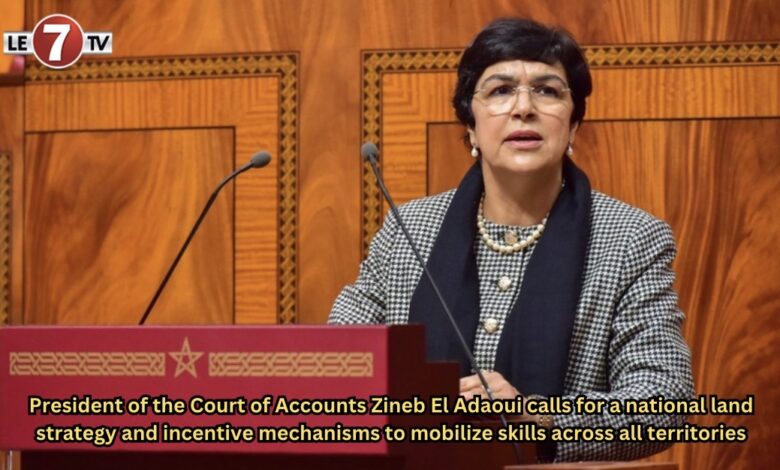
Reviewing the Court of Accounts’ key interventions before the two Houses of Parliament, Ms. El Adaoui emphasized the importance of making land available in order to stimulate and attract private investment, both in urban and rural areas.
According to her, this requires the adoption of an integrated national land strategy that ensures coherence in the interventions of the various stakeholders and facilitates investors’ access to land, alongside the establishment of appropriate mechanisms for the recovery of public real estate and properties that have been misappropriated or illegally exploited, and the adoption of coercive measures when necessary.
She noted that territories possess energy potential that makes them attractive areas for promising investments at the national level, such as renewable energies. Although the overall share of renewable energy in the electricity mix reached 45.3 percent in 2024, its contribution to electricity production did not exceed 26.7 percent nationwide, which has required maintaining a high level of dependence on fossil fuels for electricity generation.
In this regard, she recalled that the Court of Accounts recommended accelerating investments, particularly in the field of solar energy and in the electricity transmission network, notably the “Electric Highway” project linking Dakhla to Casablanca.
In connection with issues related to territorial development and the optimal use of available water resources, she explained that water management requires continued efforts toward greater rationalization and combating reprehensible and irresponsible behavior at the level of each territory, whether in regions known for abundance, those suffering from scarcity, or in contexts marked by successive contrasting climatic periods.
Considering that human resources constitute one of the fundamental pillars for the success of development programs, she underlined that the Court of Accounts calls for accelerating the preparation of an integrated national strategy to upgrade the territorial civil service.
This strategy, she explained, must take into account the spatial, social and economic specificities of each region, and be based on institutional contractual arrangements between the State and the regions in the field of human capital management, while considering the competencies devolved to territorial collectivities within the framework of the implementation of advanced regionalization.
Ms. El Adaoui added, in the same context, that the Court recommends strengthening the attractiveness of the territorial civil service through incentive mechanisms capable of attracting skills and ensuring their professional stability, and of including these mechanisms in a basic statute for the concerned categories of employees.
She also pointed out that the Court places emphasis on the importance of consolidating collective work among the various institutional stakeholders, through cooperation, pooling and the exchange of expertise and skills, in order to better deploy them at the local and territorial levels, particularly for strategic programs and projects.
Regarding the training of human capital, which represents one of the decisive factors in the process of economic and social development, she recalled that the creation of the Cities of Trades and Skills, considered one of the pillars of the roadmap for the development of initial vocational training, benefited from a specific governance framework and that its financing was secured through a multipartite agreement signed in February 2020, with an initial budget allocation of 3.6 billion dirhams, revised in 2025 to reach 5.9 billion dirhams.
However, she observed that the implementation of these Cities experienced a clear delay compared to the planned deadlines, since by the 2024-2025 academic year, seven out of the twelve establishments had been put into service, representing around 74 percent of the planned intake capacity, estimated at 34,000 places per year.
In the same vein, and regarding the Office of Vocational Training and Employment Promotion (OFPPT), a major player in the field of training and in meeting the needs of companies in productive sectors, Ms. El Adaoui specified that the Court calls for the establishment of an appropriate contractual mechanism linking the OFPPT to the State in terms of objectives, resources and expected results, through indicators with territorial and sectoral dimensions, noting that this contractualization is primarily intended to secure the financing of the roadmap projects and ensure their monitoring.
Editorial team/le7tv