Amal El Fallah Seghrouchni Highlights in New Delhi Morocco’s Vision for Sovereign and Inclusive Artificial Intelligence Based on South-South Cooperation
New Delhi – The Minister Delegate to the Head of Government in charge of Digital Transition and Administrative Reform, Amal El Fallah Seghrouchni, presented on Thursday in New Delhi Morocco’s comprehensive, coherent, and structured vision for Artificial Intelligence. This vision is built on technological sovereignty, innovation, socio-economic impact, and South-South cooperation, in line with the High Guidelines of His Majesty King Mohammed VI.

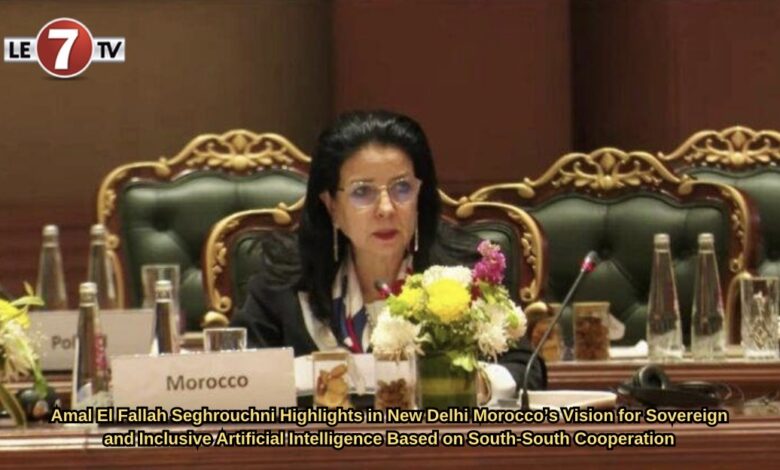
Speaking at a high-level ministerial roundtable held as part of the World AI Summit and chaired by Indian Prime Minister Narendra Modi, the minister underlined that AI represents a major opportunity to improve healthcare systems, education, resource management, and public services. However, she warned against the risks of widening inequalities, technological dependency, and the loss of digital sovereignty.
She stressed that Morocco views artificial intelligence as a long-term strategic choice, aligned with the Sovereign’s forward-looking vision, which considers investment in renewable energy, AI, and new technologies as a key driver of development, transition toward sustainable economic models, and adaptation to global transformations.
The minister also presented the “Artificial Intelligence Made in Morocco” initiative, a national roadmap aimed at positioning the Kingdom as a producer of sovereign technological solutions that reconcile innovation, competitiveness, and development impact.
She explained that this approach is based on three complementary pillars. The first concerns sovereignty and trust, through the establishment of a national framework for responsible AI, secure data governance, and sovereign cloud computing infrastructure. The objective is to ensure that AI serves the public interest while protecting rights, security, and data sovereignty. She noted that these efforts have enabled Morocco to climb 14 places in the 2025 Government AI Readiness Index, reaching 87th position worldwide.
The second pillar focuses on innovation and competitiveness, through the development of shared digital platforms, strengthening national research and development capacities, and creating technological solutions tailored to the Kingdom’s economic and social needs.
The third pillar relates to impact and adoption, with the goal of deploying concrete and measurable solutions in key sectors such as health, education, agriculture, energy, and public services.
The minister also emphasized the decisive role of human capital, highlighting Morocco’s efforts in training, upskilling, and scientific research through programs covering the entire talent pipeline, from youth qualification to advanced training.
She indicated that more than 500 accredited digital programs have been launched in higher education, with 22,649 students enrolled in strategic fields such as artificial intelligence, data science, cybersecurity, cloud computing, and software engineering. The objective is to reach 22,500 graduates per year by 2027, compared to 8,000 currently.
Regarding reskilling and career transition, she pointed to the “Job in Tech” program, which aims to train 14,000 learners over three years, including 2,664 currently undergoing training across various regions of the Kingdom.
In terms of research and academic excellence, she announced that more than 550 doctoral scholarships will be funded by 2027 in key areas including AI, data science, cloud computing, and cybersecurity.
The minister stressed that Morocco’s action in artificial intelligence is rooted in an open and inclusive vision, requiring the representation of all civilizations in accordance with the Royal Guidelines, while underscoring the strategic importance of South-South cooperation.
In this context, she referred to the “Digital for Sustainable Development” initiative, developed in partnership with the United Nations Development Programme, which positions Morocco as a regional hub for AI and data science and as a bridge between the Arab world and Africa.
She also recalled the Kingdom’s active engagement within the Digital Cooperation Organization in favor of an inclusive and practical digital transformation.
Morocco thus aspires to develop high-impact AI solutions, tested in real-life conditions and then deployed at the regional level, particularly in sectors such as water, health, education, agriculture, and the modernization of public administration.
She emphasized that artificial intelligence “must not become an invisible frontier between those who possess computing power, data, and talent, and those who do not,” adding that “our responsibility is to prevent a two-speed AI and to ensure a fair sharing of its benefits, including at the regional level for vulnerable populations.”
She concluded by affirming that “Morocco is ready to contribute to this collective dynamic, not as a mere user of technology, but as an actor, producer, and partner in building trustworthy, useful, and inclusive artificial intelligence.”
Held under the theme “Well-being for All, Happiness for All,” the World AI Summit serves as an international platform for reflection and dialogue on the future of AI and its governance challenges, with the ambition of better integrating the priorities of countries from the Global South.
The event brings together more than 100 government representatives, including over 20 heads of state and government, nearly 60 ministers and deputy ministers, as well as United Nations Secretary-General Antonio Guterres, alongside 500 global AI leaders, academics, and researchers.
Editorial team/le7tv