Rabat Hosts Meeting to Monitor Implementation of Education and Preschool Reform
Head of Government Aziz Akhannouch chaired, on Wednesday in Rabat, a meeting dedicated to monitoring the implementation of the reform of the national education and preschool system. The meeting focused on assessing the progress of priority projects launched in this sector, which ranks among the government’s top concerns in line with the High Directives of His Majesty King Mohammed VI.

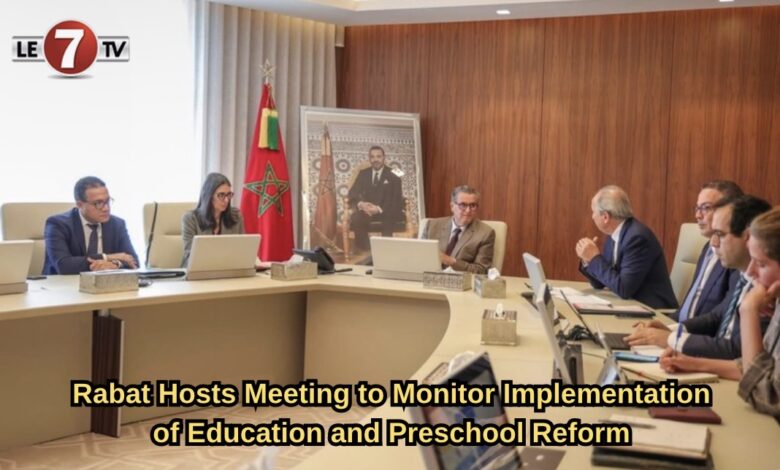
At the beginning of the meeting, the Head of Government affirmed that reforming the education system is at the heart of the government’s priorities, as a mechanism for developing human capital and a lever for strengthening the foundations of the social state, as envisioned by His Majesty the King, may God assist Him, according to a statement from the Department of the Head of Government.
He stressed that the government has mobilized the necessary financial resources and investments to improve the quality of public schools and make them a driver for strengthening social equity and equal opportunities.
The Head of the Executive also called for continued efforts to accelerate the implementation of ongoing projects and to consolidate a results-based governance approach, while initiating reflection on a national education strategy for the post-2026 period, with the aim of building a high-quality public school system that ensures equity and inclusion.
The meeting provided an opportunity to review the progress made in several priority projects, notably the generalization of preschool education, which has now reached 80 percent implementation and benefited more than 985,000 children.
Discussions also addressed the continued expansion of the “Pioneer Schools” program, which is expected to cover 80 percent of primary schools starting from the 2026–2027 academic year, after evaluations confirmed a notable improvement in students’ mastery of fundamental learning.
This development aligns with the first strategic objective of the 2022–2026 roadmap, which aims to raise the rate of mastery of fundamental learning to 70 percent.
Regarding the “Pioneer Colleges” program, positive results have been recorded in reducing school dropout rates, which declined from 8.4 percent to 4.45 percent in the institutions concerned, alongside the strengthening of support and individual guidance mechanisms.
Significant progress has also been made in reducing classroom overcrowding and reinforcing school support services, particularly in school transport and boarding facilities, especially in rural areas, in line with the principle of equal opportunities.
The meeting also highlighted the expansion of Amazigh language teaching in primary education, as well as the teaching of English at the secondary level, the statement concluded.
Editorial team/le7tv