Spain’s “No” to the United States Could Isolate Madrid and Further Strengthen Morocco
Spanish Prime Minister Pedro Sánchez’s recent decision to refuse participation in a potential military operation against Iran alongside the United States and Israel has sparked wide debate on the international stage. While some observers have praised the move as a defense of international law, it has also raised significant questions within Spain about its possible strategic consequences.

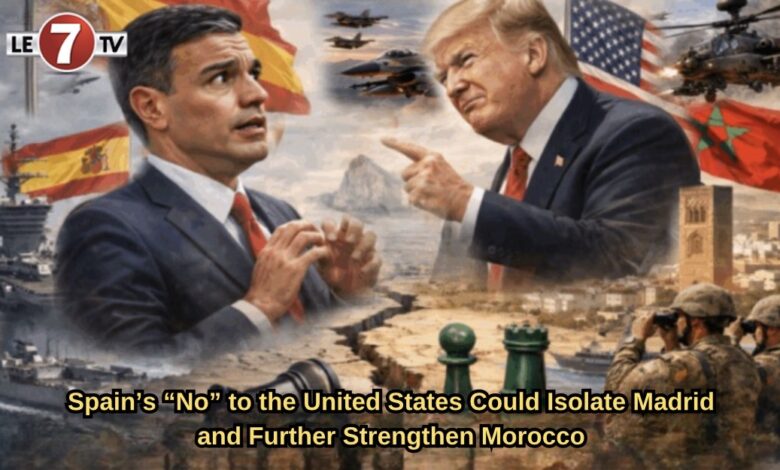
By declining to allow the use of military bases located in southern Spain by American forces, the Spanish government signaled a clear stance of diplomatic independence. This position follows earlier disagreements between Sánchez and former U.S. President Donald Trump over Spain’s defense spending within NATO, with Madrid maintaining its military budget at around 2% of GDP, below Washington’s expectations.
This decision has generated growing concern in parts of the Spanish media and among several political analysts.
Rising Concerns in the Spanish Press
Although the move has been framed by some as an assertion of national sovereignty, other commentators in Spain view it as a potential strategic misstep. Several influential voices in the Spanish press warn that such positioning could risk distancing Spain from some of its traditional allies and weakening the network of strategic partnerships it has built over decades.
Some analysts have also raised questions about the possible implications for Spain’s relationship with Morocco. In this context, they argue that Rabat could benefit from a more favorable diplomatic balance of power, particularly regarding sensitive issues such as the Spanish enclaves of Ceuta and Melilla, as well as maritime matters related to the Canary Islands.
Morocco Seen as Gaining Diplomatic Momentum
Observers note that Morocco currently maintains a strong network of international partnerships, particularly with the United States and France. In a context where Spain might appear to diverge from certain Western strategic positions, Rabat could increasingly be viewed as a stable and reliable partner for Western powers.
Moreover, the recent rapprochement between Madrid and Rabat on the issue of Western Sahara has already altered the diplomatic balance in the region. By backing Morocco’s autonomy plan, Spain effectively relinquished a traditional lever of influence it had long maintained in its relations with the kingdom.
In this evolving geopolitical environment, some analysts suggest Spain could emerge weakened by a diplomatic repositioning that blurs its traditional alliances. Conversely, Morocco appears to be consolidating its status as a key regional actor, benefiting from growing international support and increasing strategic influence across the Western Mediterranean and the Atlantic.
Behind the debate surrounding the Middle East conflict lies a broader issue: the evolving balance of power between Madrid and Rabat. If the current situation continues, several observers believe Morocco could ultimately be among the main beneficiaries of this shifting geopolitical landscape.
Translated from Abderrazzak Boussaid’s French article – le7tv