2nd Ministerial Conference on Peacekeeping in Francophone Environments: Nasser Bourita Calls for a Deep Reform of UN Peace Operations

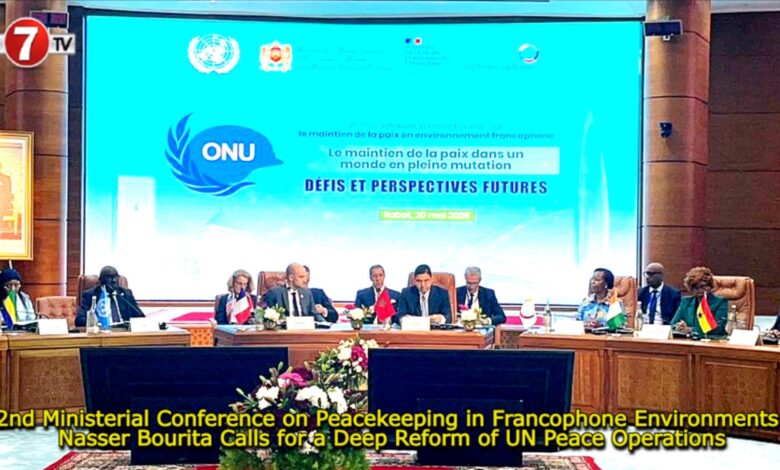
On the occasion of the 2nd Ministerial Conference on Peacekeeping in Francophone Environments, held Wednesday in Rabat under the High Instructions of His Majesty King Mohammed VI, the Minister of Foreign Affairs, African Cooperation and Moroccan Expatriates, Nasser Bourita, issued a strong call for the modernization of United Nations peacekeeping operations.
Addressing ministerial delegations, UN officials and international experts gathered in the Moroccan capital, the head of Moroccan diplomacy stressed the urgent need to adapt peace missions to the new geopolitical and security realities that are profoundly reshaping conflict zones around the world.
According to Nasser Bourita, UN operations can no longer function through rigid approaches disconnected from realities on the ground. He warned that inadequately adapted mandates risk prolonging crises instead of effectively contributing to their sustainable resolution.
The minister emphasized the importance of developing more pragmatic, prioritized and regularly reassessed mandates, supported by clear and realistic political strategies. In his view, the credibility of peace missions now depends on their ability to achieve concrete and measurable objectives rather than maintaining ambitions that are difficult to realize.
During his speech, Nasser Bourita also highlighted the deep transformations affecting peacekeeping operations, referring in particular to the rise of asymmetric threats, the growing activity of non-state armed groups, and attacks targeting UN peacekeepers in several regions of the world.
He called for stronger protection of UN personnel and the implementation of a zero-tolerance policy against violence committed against peacekeeping forces.
The minister further recalled that UN missions must remain temporary mechanisms designed to support political processes rather than replace political solutions themselves. In this regard, he stressed that the gradual withdrawal of a mission should be considered whenever political and security conditions allow it.
Nasser Bourita also underlined Morocco’s recognized experience in peacekeeping operations. Since 1960, the Kingdom has deployed more than 100,000 peacekeepers in various UN missions around the world. Today, nearly 1,340 Moroccan soldiers are mainly serving within MINUSCA in the Central African Republic and MONUSCO in the Democratic Republic of Congo.
This longstanding commitment gives Morocco particular credibility in international discussions regarding the future of peace operations and reinforces its role as a committed actor in favor of stability and multilateralism.
The minister also called for stronger coordination among Francophone countries in this strategic field, noting that the Francophone space hosts a large share of UN peacekeeping missions and accounts for a significant portion of the UN peacekeeping budget.
He advocated for building a common Francophone vision for peace and security while strengthening training, interoperability and expertise-sharing among contingents deployed in the field.
By hosting this international conference in Rabat, Morocco once again confirms its position as a platform for diplomatic dialogue and a leading actor in major issues related to peace, security and international cooperation.
Editorial Staff / Le7tv