Refereeing Under Intense Scrutiny: The Atlas Lions Refuse to See Their World Cup Quarter-Final Against France Undermined Again by Scandalous Decisions

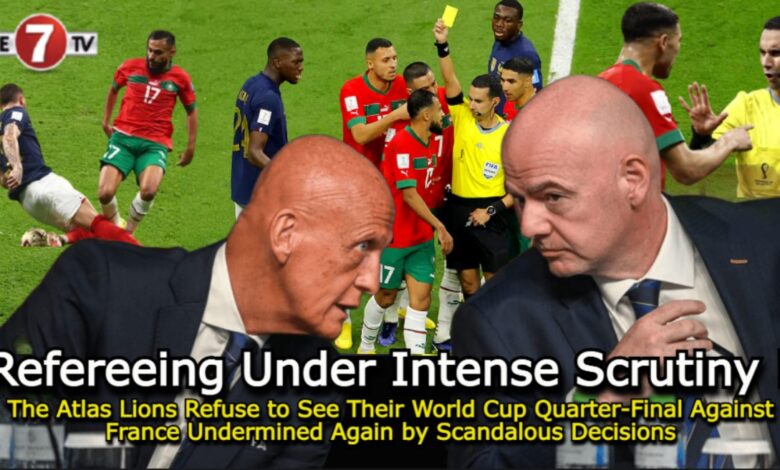
Just days before the highly anticipated 2026 FIFA World Cup quarter-final between Morocco and France, scheduled for July 9, one question dominates discussions among Moroccan supporters: will the Atlas Lions finally receive fair and impeccable refereeing ?
While this clash promises to be one of the tournament’s most captivating encounters, it also reopens a wound that has yet to heal. For many Moroccans, the memory of the 2022 FIFA World Cup semi-final in Qatar remains inseparable from what a large segment of Moroccan public opinion continues to regard as one of the most controversial refereeing performances in the national team’s recent history.
For millions of Moroccans, the memory goes far beyond the defeat itself. It reflects the belief that a historic achievement was overshadowed by a series of controversial refereeing decisions, denying the Atlas Lions the opportunity to compete on equal terms against France.
At the center of the controversy was Mexican referee César Arturo Ramos Palazuelos, whose handling of several key incidents sparked widespread outrage. A number of disputed challenges inside the French penalty area resulted in neither penalty awards nor intervention from the Video Assistant Referee (VAR), continuing to fuel debate among former international players, football analysts, and refereeing experts.
The Royal Moroccan Football Federation officially challenged the refereeing by submitting a formal complaint to FIFA, arguing that Morocco had been denied two clear penalties and criticizing the absence of VAR intervention. Although the complaint did not alter the outcome of the match, it became a defining chapter in Moroccan football history.
The controversy also reignited a broader international debate over refereeing governance at major tournaments. In recent years, officiating decisions at elite competitions have repeatedly generated worldwide criticism, raising questions about the consistency of refereeing standards, the transparency of VAR procedures, and the need for stronger oversight mechanisms to safeguard the credibility of international football.
Today, Morocco faces France once again under very different circumstances. The Atlas Lions have established themselves as one of the world’s leading football nations. Their remarkable rise has demonstrated that their place among the global elite is no longer the result of a single historic run, but of a long-term sporting project built upon exceptional talent, sound management, and sustained development.
It is precisely for this reason that Moroccan supporters are asking for only one thing: that this quarter-final be decided by the players’ talent, tactics, determination, and merit—not by refereeing decisions that could once again become the subject of controversy.
At a time when FIFA continues to emphasize its commitment to protecting the integrity and fairness of international competitions, the football world will closely monitor the standard of officiating in this match. A fixture of such magnitude cannot afford any significant doubt. Every decision must be made with professionalism, independence, and impartiality, as any major error could not only influence the fate of a nation but also further erode supporters’ confidence in the institutions responsible for ensuring the fairness of the game.
The Atlas Lions are not asking for special treatment. They are simply demanding what every team competing in a FIFA World Cup has the right to expect: fair, consistent, and impartial refereeing. If the best team prevails, let it do so on the pitch through the quality of its football—not through decisions that leave even the slightest doubt about the integrity of the competition.
Abderrazzak Boussaid / Le7tv