Dakhla-Oued Eddahab: Three agreements signed to strengthen regional leadership in digital transformation and energy transition
Three agreements related to digital transformation and energy transition were signed on Friday in Dakhla with the aim of reinforcing the position of the Dakhla-Oued Eddahab region as a hub for innovation, renewable energy and the digital economy.

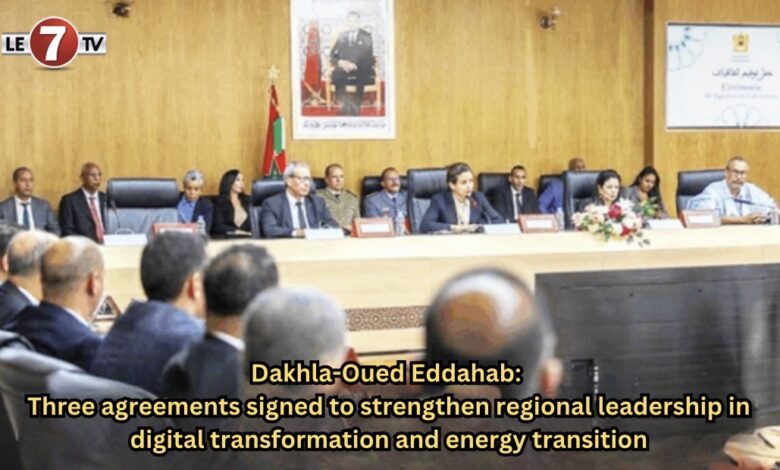
The signing ceremonies took place at the headquarters of the Wilaya of the region, in the presence of the Minister of Energy Transition and Sustainable Development, Leila Benali, the Minister Delegate to the Head of Government in charge of Digital Transition and Administration Reform, Amal El Fallah Seghrouchni, the Wali of the region and Governor of the province of Oued Eddahab, Ali Khallil, as well as the President of the Regional Council, El Khattat Yanja.
The first agreement focuses on supporting renewable energy and green hydrogen projects in the region, in addition to enhancing regional energy integration and interconnection. It also covers cooperation in the development of new and renewable energies, the production of green hydrogen and clean fuels, water desalination, data center supply, improved energy efficiency and support for national and regional energy infrastructure.
The second agreement concerns the establishment of the Jazari Institute for Artificial Intelligence and Energy Transition, a scientific and innovative institution with national and continental scope.
The institute will work on developing intelligent energy management solutions, supporting applied scientific research in new forms of energy, training new generations in artificial intelligence and clean energy, promoting innovation and entrepreneurship in the green economy and reinforcing collaboration between universities, research centers, industry and market needs.
The third agreement provides for the creation of the Green Data Center “Igoudar” in Dakhla, a strategic data infrastructure powered exclusively by renewable energy. The project aims to strengthen Morocco’s digital sovereignty by hosting secure national data centers, reduce the carbon footprint of the digital sector through clean energy, support investment in cloud computing and artificial intelligence, and generate high value-added employment through advanced digital services.
In her remarks, Minister Benali emphasized that the Dakhla-Oued Eddahab region is experiencing unprecedented development across multiple sectors, particularly energy transition. She recalled that the southern provinces already host renewable energy facilities with an installed capacity of 1,442 MW, including 101 MW of solar power and 1,341 MW of wind power, representing an investment of nearly 22 billion dirhams.
She added that the national electricity production plan for 2025–2030 includes new renewable energy projects in the southern provinces with a combined capacity exceeding 1,400 MW and investment exceeding 15 billion dirhams.
Through these initiatives, she affirmed, the ministry is committed to pursuing its work in line with the High Guidelines of His Majesty King Mohammed VI, in order to strengthen Morocco’s leadership in renewable energy and establish the southern provinces as a major hub for sustainable development, innovation and intercontinental connectivity.
For her part, Minister Seghrouchni stated that the signature of these agreements marks the foundation of a new phase driven by large-scale Moroccan projects with continental dimension, based on clean energy and advanced technologies, placing knowledge and the human component at the center of development.
Dakhla is set to become a leading African platform for renewable energies, digitalization and artificial intelligence, she underlined, reaffirming the ministry’s commitment to support these ambitious initiatives and contribute to a sustainable development momentum aligned with the visions and orientations of His Majesty King Mohammed VI.
Editorial team/le7tv