Moroccan People Celebrate on Friday 55th Birthday of HRH Prince Moulay Rachid
Rabat - The Moroccan people join the Royal Family in celebrating the 55th birthday of HRH Prince Moulay Rachid on Friday, a happy event that provides an opportunity for all Moroccans to express their warmest congratulations and sincere wishes of happiness and long life to His Majesty King Mohammed VI, HRH Crown Prince Moulay El Hassan, HRH Prince Moulay Rachid and the entire August Royal Family.

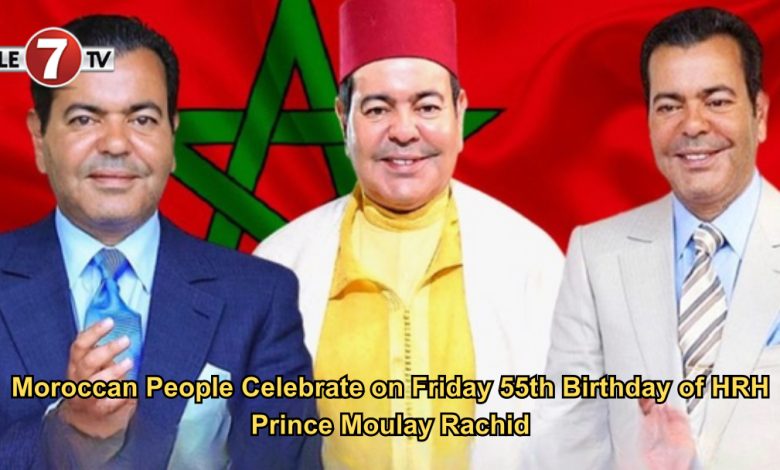
Born in Rabat on June 20, 1970, HRH Prince Moulay Rachid graduated with honors in May 1993 from the Faculty of Legal, Economic and Social Sciences in Rabat with a degree in Public Law (specializing in Internal Administration) and a diploma in Comparative Law.
Three years later, His Royal Highness obtained his second Certificate of Advanced Studies (International Relations option) with honors.
His Royal Highness publicly defended, on May 18, 2001 at the Université Montesquieu-Bordeaux IV, a doctoral thesis in Law on “The Organization of the Islamic Conference: Study of a specific international organization”, obtained with the distinction “Very Honorable with the congratulations of the jury and special mention for its publication”, in view of the interest of the subject and the quality of the work.
From an early age, HRH Prince Moulay Rachid has been involved in cultural, social and sporting activities. In this regard, His Royal Highness has chaired the National Federation of Moroccan Scouting since 1997, breathing new life into the organization.
In the same spirit and with the same commitment, HRH Prince Moulay Rachid presides over the Royal Moroccan Hunting Arms Shooting Federation, the Marrakech International Film Festival Foundation and the Hassan II Golf Trophy Association.
Since January 2018, His Royal Highness has also been president of the Royal Moroccan Golf Federation.
His Royal Highness chairs major events in various fields, as well as official ceremonies, and represents His Majesty the King at major national and international events, to promote Morocco’s international and regional influence.
Last Monday, HRH Prince Moulay Rachid chaired an Extraordinary General Assembly of the Royal Moroccan Golf Federation (FRMG). On April 17, His Royal Highness chaired the opening of the 30th International Book and Publishing Fair (SIEL) at the OLM-Souissi arena in Rabat.
On April 9, His Royal Highness Prince Moulay Rachid, accompanied by Their Highnesses Princes Moulay Ahmed and Moulay Abdeslam, visited the Moulay Idriss Al Azhar Mausoleum in Fez, on the occasion of the circumcision of HH Prince Moulay Ahmed and HH Prince Moulay Abdeslam, in line with authentic Moroccan traditions.
On February 7, HRH Prince Moulay Rachid chaired at the archaeological site of Chellah in Rabat, a gala dinner offered by His Majesty King Mohammed VI, on the occasion of the 49th Hassan II Golf Trophy and the 28th Lalla Meryem Cup. The next day, His Royal Highness Prince Moulay Rachid chaired the award ceremony for the winners of the 49th Hassan II Golf Trophy and the 28th Lalla Meryem Cup at the Royal Golf Dar Es Salam in Rabat.
On December 7, HRH Prince Moulay Rachid represented His Majesty King Mohammed VI at the reopening ceremony of Notre-Dame Cathedral in Paris. Later on the same day, HRH Prince Moulay Rachid took part at Elysée Palace, in the dinner offered by French President Mr. Emmanuel Macron and Mrs. Brigitte Macron in honor of the heads of State, government and international organizations invited to this ceremony.
On November 30, HRH Prince Moulay Rachid, President of the Marrakech International Film Festival Foundation, chaired at the El Badi’ Palace, a dinner offered by His Majesty King Mohammed VI on the official opening of the 21st edition of the Marrakech International Film Festival.
On October 28, His Royal Highness was present alongside HRH Crown Prince Moulay El Hassan, Her Royal Highness Princess Lalla Khadija, and Her Royal Highness Princess Lalla Meryem at the official welcome ceremony, presided over by His Majesty the King, for French President Emmanuel Macron and his spouse, who were on a state visit to Morocco.
That same day, HRH Prince Moulay Rachid took part in the signing ceremony of several agreements between the Kingdom of Morocco and the French Republic, chaired by His Majesty the King Mohammed VI, who was also accompanied by HRH Crown Prince Moulay El Hassan, HRH Princess Lalla Khadija and HRH Princess Lalla Meryem, and the French President, H.E.M. Emmanuel Macron, who was accompanied by his spouse Brigitte Macron.
The following day, His Majesty the King, accompanied by HRH Crown Prince Moulay El Hassan, HRH Prince Moulay Rachid, and Their Royal Highnesses Princesses Lalla Khadija, Lalla Meryem, Lalla Asmaa, and Lalla Hasnaa, hosted a state dinner in honor of the French President Emmanuel Macron and his spouse Brigitte Macron.
On September 30, 2024, HRH Prince Moulay Rachid chaired, at the Mohammed VI Exhibition Center, the opening ceremony of the 15th edition of the El Jadida Horse Show,held under the High Patronage of HM the King, under the theme “Horse breeding in Morocco: Innovation and challenge”.
HRH Prince Moulay Rachid’s birthday is an opportunity for the entire Moroccan people to reaffirm their unwavering attachment to the Glorious Alaouite Throne, and their permanent mobilization behind His Majesty King Mohammed VI for the success of the great development projects launched by the Sovereign for the prosperity of His loyal people.
Editorial team/le7tv