FAR vs JSK: Visas denied to Moroccans. When the Algerian regime turns sport into a political propaganda tool
Once again, the Algerian regime has chosen the path of closure, tension and the political instrumentalization of sport. On the eve of a major continental fixture, the Algerian authorities simply rejected all visa applications submitted by AS FAR supporters, and, even more seriously, by journalists, media professionals and even the club’s official communication unit, which is usually authorized to accompany the team during its travels, training sessions and competitions.

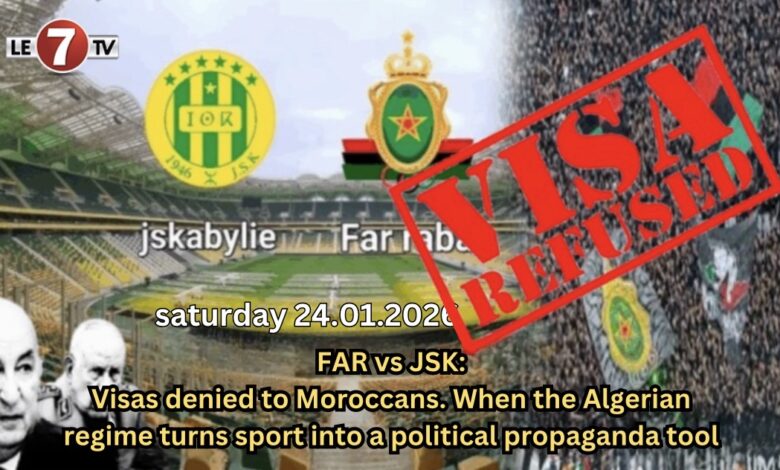
This blanket refusal, issued without any credible justification, deliberately deprives the Moroccan club of the support of its fans during its trip to Algeria to face JS Kabylie, as part of the third group-stage match of the CAF Champions League. It is a decision heavy with meaning, one that goes far beyond the sporting context and once again reveals the Algerian regime’s obsession with politicizing everything, including football.
When the CAF speaks of fair play, Algiers responds with exclusion
The CAF Champions League is meant to be a space of African fraternity, openness and mutual respect among the peoples of the continent. By closing its sporting borders to supporters, journalists and communication staff of a visiting club, Algeria sends a clear message: fair play is nothing more than a slogan when it clashes with domestic political agendas.
This attitude stands in stark contrast to Morocco’s approach, where African clubs, their supporters and the media are welcomed in a calm, professional and respectful environment, regardless of political or diplomatic circumstances. The comparison is harsh, but revealing.
Sport as collateral damage of a regime running out of steam
This latest episode is part of a long series of arbitrary decisions taken by an Algerian regime that appears increasingly isolated, nervous and distrustful, even toward spaces that should remain neutral. Denying access to journalists and an official communication unit is not only absurd, but also a direct attack on press freedom and on the proper conduct of international competitions.
Through this decision, it is not AS FAR that is being punished, but rather the image of African football itself, taken hostage by extra-sporting considerations that have no place on the pitch.
Despite this hostile context and the forced absence of its supporters, AS FAR will approach this match with determination, discipline and sporting spirit, faithful to its values and its history. The Moroccan club will play to win on the field, where administrative maneuvers and political decisions have no legitimacy.
Translated from Abderrazzak Boussaid’s French article – le7tv