Fouzi Lekjaa: The 2026 Finance Bill is part of a development dynamic that reconciles economic and social priorities
The Minister Delegate in charge of the Budget, Fouzi Lekjaa, stated on Wednesday in Rabat that the 2026 Finance Bill (PLF) is part of a historical process spanning more than 26 years, in line with the High Royal Guidelines aimed at building a development model that reconciles economic and social dimensions.

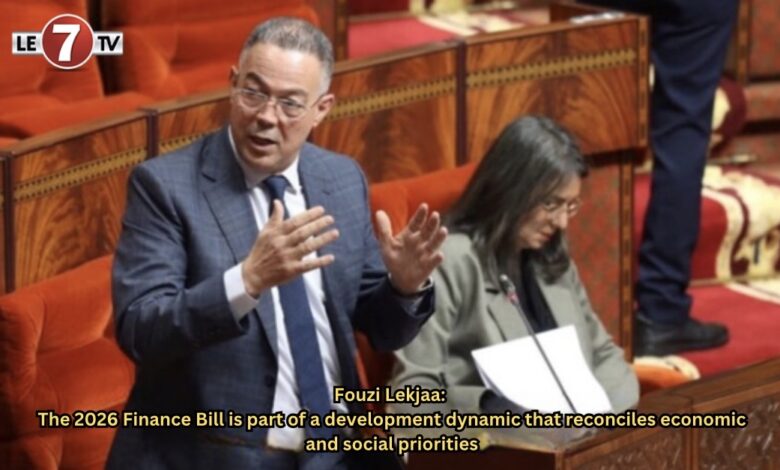
Speaking at a plenary session in the House of Councillors, dedicated to the general discussion of the 2026 Finance Bill, Mr. Lekjaa recalled that the government has, since the beginning of its mandate, worked to implement the social state project in accordance with a clear agenda and a defined timeline.
He noted that around 12 million citizens currently benefit from direct assistance, under a system based on targeting mechanisms. He stressed that this project cannot be evaluated over the span of a single budget year or a single governmental or parliamentary term. For Mr. Lekjaa, it is a gradual process built on capitalisation and accumulation, until it reaches full maturity and achieves its goals.
The Minister explained that the cost of this governmental effort amounts to nearly 50 billion dirhams, adding that several aspects require ongoing monitoring and a dynamic and positive approach, particularly regarding the eligibility criteria for the various categories, which are currently being reviewed.
Regarding housing, Mr. Lekjaa said that a political decision was made to move from a system based on tax exemptions to one founded on direct assistance, with clear criteria, conditions and sufficient financial resources for its implementation. This orientation, he continued, is clearly reflected in the budgetary tables and projections of the Finance Bill.
Moreover, the Minister indicated that the social pillar also includes sustained efforts to improve the education and health systems. He emphasized that the acceleration of the construction, rehabilitation and planning of hospitals, as well as the funds allocated to them, falls within a structuring political choice reflected in a budget classification validated by the Organic Law on Finance Bills.
On the economic front, Mr. Lekjaa affirmed that the Kingdom’s strategic choices are a source of pride for all, given their relevance and ability to adapt to global transformations and shocks. He recalled that the national economy managed to overcome the consequences of the COVID-19 pandemic, demonstrating strong resilience, and is on track to close the current fiscal year with a deficit of 3.5 percent and a reduction of public debt to below 66 percent, while maintaining the same momentum in 2026. This, he said, is a major achievement for the Kingdom.
Regarding tax reform, Mr. Lekjaa pointed out that it allowed Morocco to record an annual 18 percent increase in revenues without raising tax pressure. On the contrary, he noted, the corporate tax rate was reduced from 30 percent to 20 percent for companies with a turnover of less than 100 million dirhams.
As for the new generation of integrated territorial development programmes, announced by His Majesty King Mohammed VI in the Throne Day Speech, Mr. Lekjaa said that the government has responded to the High Royal Guidelines by integrating all necessary measures to ensure optimal and timely implementation. He recalled the creation of a special account to host the various programmes mentioned in the Royal Speech.
The government, he added, has launched a public debate involving various segments of society, with the aim of developing programmes that respond to citizens’ priorities. These programmes will be included under this special account, which will be allocated funding well above the 20 billion dirhams initially planned in the Finance Bill.
Editorial team/le7tv