Morocco’s Policy Toward West Africa Highlighted in Dakar
Morocco’s policy toward West Africa was the focus of a conference held Tuesday in Dakar at the initiative of the Senegal Defense Institute, under the Senegalese Armed Forces, in the presence of prominent figures from various fields.

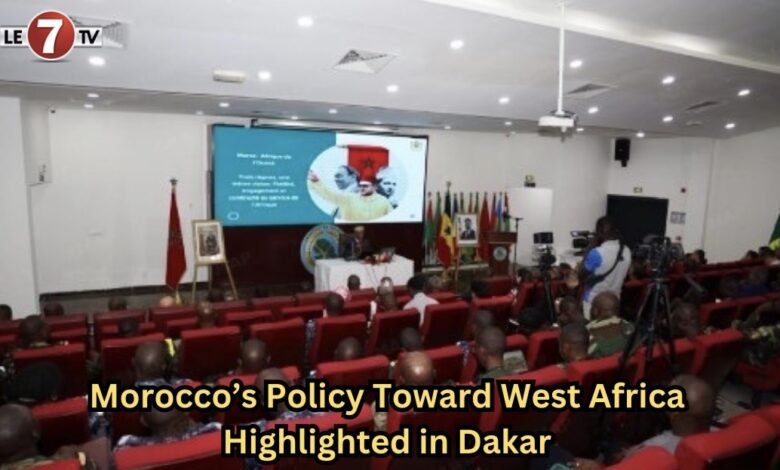
Held under the theme “Morocco’s Policy Toward West Africa: Logic of Cooperation and Shared Ambitions,” the event highlighted the longstanding ties between Morocco and Senegal, as well as the depth of multidimensional relations between the Kingdom and the countries of the sub-region.
On this occasion, Morocco’s Ambassador to Senegal, Hassan Naciri, outlined the main pillars of Morocco’s policy in West Africa, built on shared ambitions and a Royal vision that places Africa at the heart of national priorities.
“Today, Morocco’s policy in West Africa is neither a historical exercise nor a simple foreign policy analysis. It is a strategic reflection at the core of the profound transformations underway on our continent,” the Ambassador stressed, adding that the theme of the conference “is not a slogan: it reflects a geographical reality, a human proximity, a political density, and a Royal vision that places Africa at the center of national priorities.”
Far from being a monolithic bloc, he added, West Africa stands at the crossroads of major dynamics such as demographic growth, energy transition and the development of new logistical corridors.
In this evolving context, Mr. Naciri emphasized that Morocco is not an external actor nor a distant observer, but rather “an African power firmly rooted in the West African space” due to its geography, historical heritage, spiritual and economic ties, and a determined political will to build a shared future.
In this regard, he cited the many agreements signed with African countries, including free trade agreements aimed at facilitating commercial activity, the Atlantic Africa Gas Pipeline project, as well as the Royal initiative to grant access to the Atlantic Ocean for Sahel States. He also highlighted Morocco’s vision based on co-development, alignment of economic, security, religious and cultural priorities, and the Kingdom’s positive leadership built on confidence, reliability, and tangible action rather than speeches.
According to him, analyzing this policy requires understanding how Morocco anchors its action within major trends shaping West Africa, notably through deepening economic integration, supporting energy transition, reducing the isolation of the Sahel, strengthening maritime security, fostering digital development, consolidating religious diplomacy, promoting student mobility, and ensuring responsible management of migration-related challenges.
“The longstanding relations between our countries are supported by several factors,” he continued, “including economic ties with investments in various sectors, notably banking, and politico-diplomatic relations built on a shared pan-African vision, in addition to other powerful levers such as culture and religion, notably through religious diplomacy.”
Mr. Naciri concluded his address with recommendations aimed at strengthening partnerships in order to accelerate synergies, improve project governance, boost sectoral cooperation and deepen strategic and human ties.
Editorial team/le7tv