Morocco–Mauritania: Toward strengthening cooperation in decentralization and territorial planning
Strengthening cooperation between Morocco and Mauritania in the areas of decentralization and territorial planning was the focus of working meetings recently held in Nouakchott by a Moroccan delegation with representatives of the Mauritanian government and bodies responsible for local and territorial affairs management.

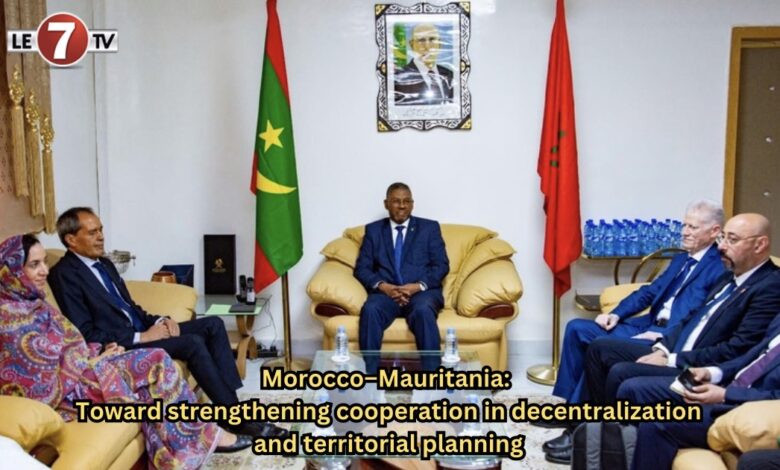
These meetings, held in the presence of Morocco’s Ambassador to Mauritania, Hamid Chabar, provided an opportunity to discuss several issues, including prospects for developing cooperation between the two countries through the preparation of a roadmap aimed at consolidating relations between Moroccan and Mauritanian territorial authorities and establishing effective partnerships in areas related to local governance, including public services, urban development and territorial planning.
In this context, the Moroccan delegation, which included the Governor in charge of the Cooperation and Documentation Pole at the General Directorate of Territorial Communities, Abdelouahab El Jabri, the President of the Association of Regions of Morocco, Mbarka Bouaida, and the President of the Moroccan Association of Presidents of Communal Councils, Mounir Lymouri, met in particular with the Mauritanian Minister Delegate to the Minister of the Interior, Decentralization and Local Development, in charge of Decentralization and Local Development, Yacoub Ould Salem Vall, as well as with representatives of the Mauritanian Association of Regions and the Mauritanian Association of Mayors.
In a statement to MAP, Ms. Bouaida said that the discussions between the Moroccan delegation and the Mauritanian minister delegate were an opportunity to commend the fraternal, close and deep relations uniting the two countries under the enlightened leadership of His Majesty King Mohammed VI and His Excellency President Mohamed Ould Cheikh Ghazouani, and to reaffirm the role of decentralization as a method of managing territorial affairs adopted by both countries. She also noted that the roadmap for decentralized cooperation between the two countries was among the key items on the agenda of the delegation’s meetings, specifying that it aims to establish an appropriate framework for cooperation between Moroccan and Mauritanian territorial authorities.
She further stressed the “shared ambition to enrich the roadmap with ideas and projects that help bring viewpoints closer together and strengthen relations between Moroccan and Mauritanian elected officials.” In this regard, Ms. Bouaida pointed out that both parties are committed to strengthening their cooperation through several axes, including support for decentralization and advanced regionalization processes, the development and strengthening of managerial and institutional capacities, the stimulation of local economic growth and innovation, as well as the promotion of cultural exchanges and the improvement of the quality of education and training.
In addition, the Moroccan delegation discussed with its Mauritanian counterparts the modalities enabling Mauritanian local authorities to benefit from the financial and technical support of the “African Fund for the Support of International Decentralized Cooperation of Territorial Authorities,” she said, assuring that it is a “Moroccan initiative that has met with great success among African local authorities,” as it contributes directly to the sustainable and integrated development of beneficiary communities and pays particular attention to projects and activities with a direct impact on local African populations.
During this visit, discussions also focused on the third session of the Morocco–Mauritania Regions Forum on the theme “Decentralization and Local Development,” scheduled for early 2026. The forum, whose first session was held in Nouakchott and the second in Rabat, will address a range of issues related to regional specificities and competencies, the implementation of regulatory laws, as well as challenges and successful experiences.
Editorial team/le7tv