2030 World Cup Final: No, Mr. Louzán, Morocco is indeed the “natural choice”, despite Spanish posturing
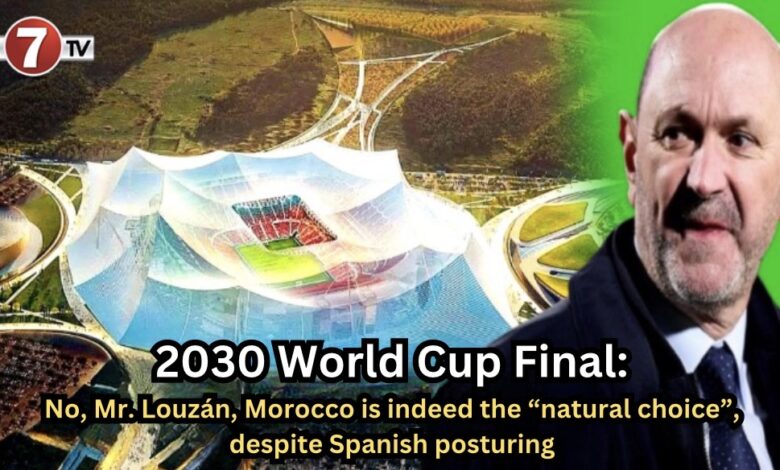
The recent statements by the President of the Royal Spanish Football Federation (RFEF), Rafael Louzán, claiming that the 2030 World Cup final will be played in Spain, amount more to political bravado than to any institutional decision. At this stage, FIFA has not officially decided either the venue of the final or the definitive allocation of the major matches of this historic edition.

Certainly, Spain, recently designated as a co-host of the Centenary World Cup alongside Morocco and Portugal, has widely recognized experience in organizing major international competitions. But this expertise, however respectable it may be, cannot replace the FIFA decision-making process, as FIFA alone has the authority to award the 2030 World Cup final.
Contrary to Rafael Louzán’s categorical claims, several leading Spanish media outlets, including Cadena SER, were quick to point out that FIFA does not plan to make any definitive announcement before the 2026 World Cup. This clarification significantly downplays the scope of his remarks and confirms that the race to host the final remains completely open.
In this context, Morocco is moving forward without noise, but with concrete arguments. The Kingdom is in the process of building what will be, upon completion, the largest football stadium in the world, with a planned capacity of 115,000 seats. This exceptional infrastructure, designed in line with the highest FIFA standards, is clearly intended to host a World Cup final.
Beyond the stadium issue alone, Morocco is presenting a comprehensive project: accelerated modernization of sports and transport infrastructure, proven experience in hosting international events, institutional stability, and strong political commitment at the highest level of the State. All these elements make the Kingdom an extremely serious, credible and legitimate candidate to host the most symbolic match of the 2030 World Cup.
Attempts to downplay Morocco’s bid, notably through references to isolated incidents that occurred during past sporting events, appear all the more clumsy as they contrast with the consistently positive assessments expressed by international bodies regarding the momentum of Moroccan sport.
The 2030 World Cup, the centenary edition, is not merely a matter of national prestige. It must embody a vision and a projection toward the future of world football. In this respect, Morocco is not staking its claim through declarations, but by patiently building a solid, structured bid that meets FIFA’s requirements.
Ultimately, far from hasty announcements, one certainty remains: the venue of the 2030 World Cup final has not yet been designated. And when FIFA makes its decision, facts, infrastructure and vision will carry far more weight than rhetorical posturing.
Translated from Abderrazzak Boussaid’s French article – le7tv