Nasser Bourita held talks with Secretary of State at the Ministry of Foreign Affairs and International Cooperation of the Kingdom of Cambodia Sun Sovanna.

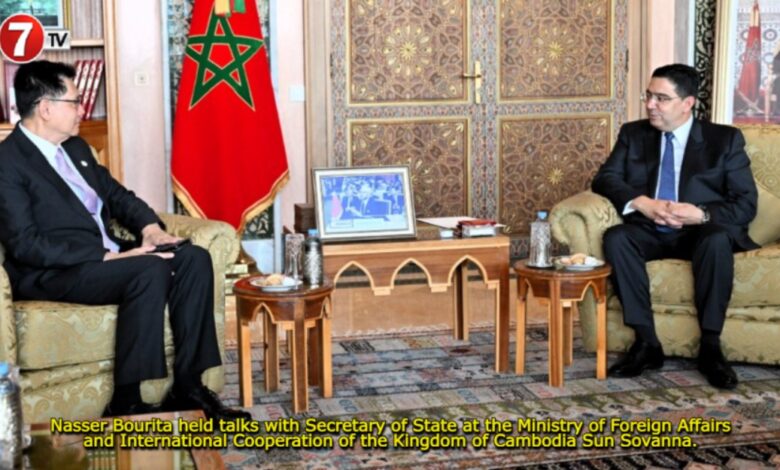
Minister of Foreign Affairs, African Cooperation and Moroccan Expatriates Mr. Nasser Bourita held talks on Thursday in Rabat with Secretary of State at the Ministry of Foreign Affairs and International Cooperation of the Kingdom of Cambodia Mr. Sun Sovanna.
On this occasion, Mr. Sovanna congratulated Morocco on organizing the 2nd Ministerial Conference on Peacekeeping in a Francophone Environment.
During the meeting, the two officials also discussed the holding of the 20th Francophonie Summit, scheduled to take place in Phnom Penh, Cambodia, in November 2026.
The talks also provided an opportunity to reaffirm the excellence of bilateral relations marked by mutual respect, esteem and support, which were significantly strengthened following the signing of a multidimensional joint communiqué during the videoconference meeting held on October 21 between Mr. Bourita and his Cambodian counterpart Prak Sokhonn.
In this joint communiqué, Cambodia expressed its support for the Moroccan autonomy plan, as well as for the sovereignty and territorial integrity of the Kingdom. “While welcoming Morocco’s efforts to achieve a negotiated political solution to this regional dispute through the autonomy plan submitted by Morocco in 2007, H.E. Prak Sokhonn reiterated Cambodia’s full support for the sovereignty and territorial integrity of the Kingdom of Morocco,” the joint communiqué stated.
Cambodia had also praised Morocco’s serious, realistic and credible efforts to put an end to this regional dispute and expressed its full support for the efforts undertaken by the UN Secretary-General and his Personal Envoy for the Sahara, in line with the parameters set out in the relevant Security Council resolutions on the issue.
Reaffirming their unwavering attachment to the values and principles of peace, the two countries stressed in the communiqué their rejection of all separatist agendas aimed at undermining the sovereignty and territorial integrity of UN member States, specifying that threats posed by separatist entities to political security and stability in many regions are as serious as those posed by terrorist and extremist groups.
La rédaction/Le7tv