Nasser Bourita Takes Part in the Board of Peace on Gaza and Confirms Morocco’s Commitment to International Aid
Minister of Foreign Affairs Nasser Bourita participated on Thursday in the first meeting of the “Board of Peace” dedicated to the reconstruction of Gaza, an international initiative chaired in Washington by the U.S. President. According to information shared during the meeting, forty countries as well as the United Nations were represented at this inaugural session.

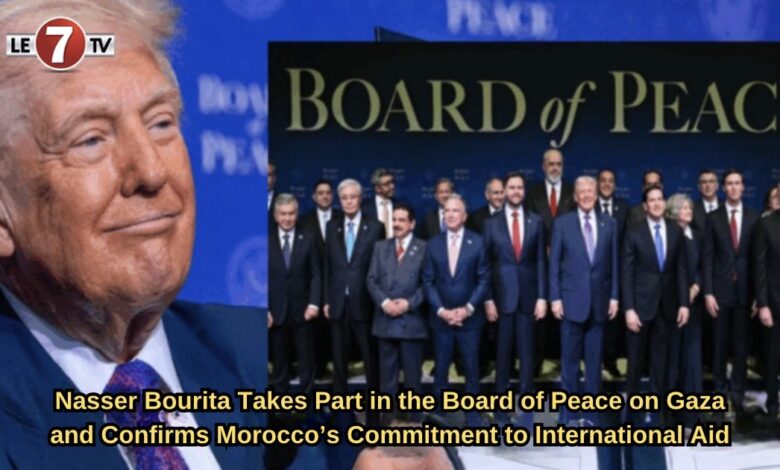
International Funding for Reconstruction
During the discussions, Donald Trump announced that members of the council had pledged approximately $7 billion to finance an aid program aimed at rebuilding the Palestinian territory, citing Morocco among the contributors. Other countries listed included Bahrain, Qatar, Saudi Arabia, Uzbekistan, Kuwait, and the United Arab Emirates. This amount exceeds the $5 billion previously mentioned by Washington.
Morocco is among the founding members of this international body. In January, King Mohammed VI accepted the American invitation to join this diplomatic mechanism, with each participating state required to contribute $1 billion to obtain permanent status.
The U.S. President also indicated that certain countries had committed to sending troops and police forces to support a future international stabilization force. He notably thanked Indonesia for pledging a contingent of 1,000 soldiers. Albania, Kosovo, and Kazakhstan reportedly also offered personnel. Unconfirmed reports further suggest possible Moroccan participation in this arrangement.
During his remarks, Donald Trump stated that the war in Gaza had ended thanks to the ceasefire that came into effect in October, despite reported violations on the ground. He downplayed ongoing tensions, referring to “small flare-ups,” and suggested that Hamas might lay down its arms, while acknowledging that the situation remains “very complex.”
The American president also pledged that his administration would work toward a “brighter future” for Gaza and the broader Middle East. He further announced that FIFA would raise $75 million to fund football-related projects in the enclave.
The U.S. executive leader also referred to ongoing negotiations with Iran, praising the role of his adviser Jared Kushner and special envoy Steve Witkoff. His statements come as BBC Verify recently confirmed the presence of a U.S. aircraft carrier near Iranian waters, heightening international concerns.
Presenting this initiative as one of the major projects of his term, Donald Trump said he intends to make the Board of Peace a central instrument for resolving global conflicts, claiming that his administration has already helped end eight wars — with a ninth potentially to follow.
Editorial team/le7tv