Morocco, Slovakia Determined to Further Strengthen Partnership in all Areas of Common Interest
Rabat - Morocco and Slovakia have reaffirmed their determination to further strengthen their bilateral cooperation in all areas of common interest and concurred to promote regional and international cooperation to address global challenges, particularly in the areas of peace and security.

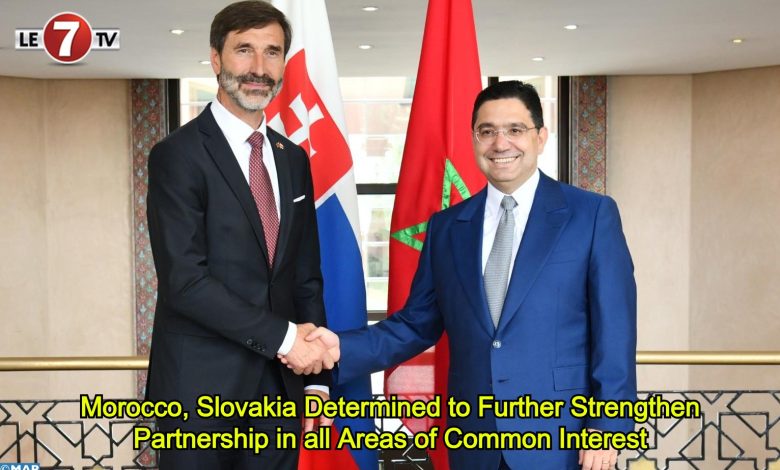
In a Joint Statement issued following their talks, the Minister of Foreign Affairs, African Cooperation and Moroccan Expatriates, Nasser Bourita, and the Slovak Minister of Foreign and European Affairs, Juraj Blanár, “reaffirmed their commitment to deepening bilateral relations in the political, economic, cultural, and scientific fields.”
The two parties “agreed on the importance of strengthening political dialogue and promoting high-level visit exchange.” As part of this dynamic, a Memorandum of Understanding establishing a mechanism for political consultations between the two departments was signed by both ministers.
Both countries also underscored “the significance of fostering regional and global cooperation to address common challenges such as peace and security, conflict prevention, climate change, security, migration, and sustainable development,” the Joint Statement adds.
At the parliamentary level, the two ministers underlined the importance of interparliamentary contacts to intensify exchanges, particularly within the framework of the Inter-Parliamentary Union (IPU).
With regard to culture, Morocco and Slovakia stressed the importance of bilateral cooperation in the cultural and academic fields as a lever to promote human and economic development, and to strengthen exchanges at both intergovernmental and civil society levels, particularly in science, research, innovation, and the blue economy.
The two countries “underlined the importance of giving new impetus to their economic cooperation in sectors of common interest, particularly those with high added value,” particularly energy, environmental protection, logistics, agriculture, the automotive industry, and green technologies.
In this context, the Joint Statement expressed both parties’ willingness to “facilitate trade by simplifying customs procedures, expanding market access, and effectively implementing trade agreements,” to “promote mutual investments,” notably through targeted support for SMEs, and to “regularly organize business forums.”
The two countries reaffirmed “their mutual commitment to strengthen dialogue and cooperation in the areas of security and migration, with particular focus on combating irregular migration,” according to the Joint Statement.
Rabat and Bratislava also concurred to deepen their collaboration in the fight against terrorism.
At the United Nations level, the two countries welcomed their mutual support for their respective candidacies for the UN Security Council for the 2028–2029 term, and voiced “their will to coordinate their actions to maintain international peace and security.”
The two parties also “committed to continuing their consultation and coordination within international organizations on multilateral issues of common interest,” the Joint Statement reads.