Morocco, Ecuador Reaffirm Commitment to Strengthening Partnership
Rabat - Morocco and Ecuador reaffirmed on Friday their commitment to a strengthened partnership, welcoming the positive momentum in their bilateral relations.

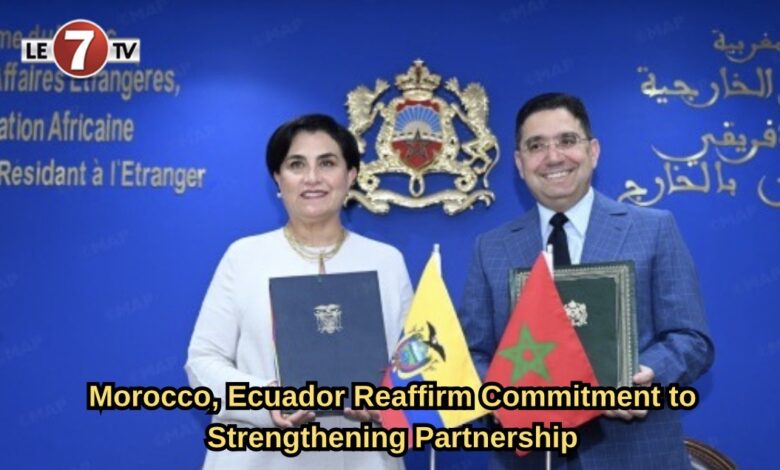
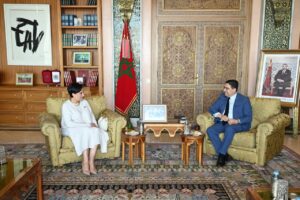
In a Joint Communiqué signed following the meeting held in Rabat between Minister of Foreign Affairs, African Cooperation and Moroccan Expatriates Nasser Bourita and Minister of Foreign Affairs and Human Mobility of the Republic of Ecuador Gabriela Sommerfeld, the two officials highlighted excellent bonds of friendship and solidarity uniting the two countries and expressed their shared willingness to enshrine their bilateral relations by giving them renewed substance for the benefit of both Nations.
During their talks, they also praised the positive momentum within their bilateral relations and reiterated their shared will to further elevate them.
The two ministers particularly focused on strengthening economic cooperation. In this regard, they emphasized that the presence of a delegation of Ecuadorian business leaders reflects a shared desire to transform political proximity into concrete projects, to the benefit of both countries’ economies.
Bourita and Sommerfeld then welcomed the prospects of signing agreements on the reciprocal protection of investments and the avoidance of double taxation, as well as the upcoming creation of a Joint Economic and Commercial Commission.
Furthermore, the two countries praised the cooperative momentum generated between their respective economic institutions, notably between the Moroccan Investment and Export Development Agency (AMDIE) and PROECUADOR, as well as the planned opening of an Ecuadorian trade office in Morocco covering the Maghreb region.
In this regard, the two ministers welcomed the meetings held between the delegation of Ecuadorian business leaders, coordinated by the Ecuadorian Federation of Exporters (FEDEXPOR), and their Moroccan counterparts, led by the General Confederation of Moroccan Enterprises (CGEM).
On the international front, the two parties discussed key regional and international issues, notably the situation in Africa, Latin America, and the Middle East, and reaffirmed their commitment to multilateralism, based on respect for international law, cooperation, and the peaceful resolution of disputes.
In this context, the Ecuadorian official lauded the commitment of His Majesty King Mohammed VI in His capacity as Chairman of the Al-Quds Committee, as well as the Kingdom’s tireless efforts for stability in the Middle East.
Editorial team/le7tv