The Education, Cultural and Social Affairs Committee of the House of Councillors Adopts the Bill on the Reorganization of the National Press Council
The Education, Cultural and Social Affairs Committee of the House of Councillors adopted on Monday, by a majority vote, Bill No. 026.25 relating to the reorganization of the National Press Council, as transmitted by the House of Representatives.

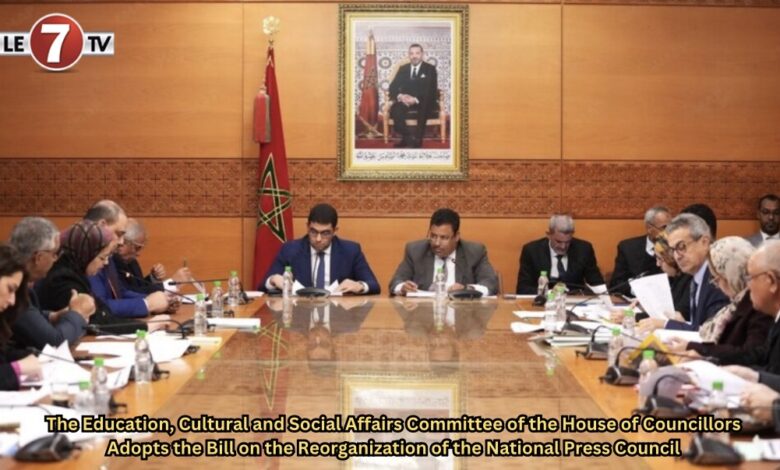
During the session, held in the presence of the Minister of Youth, Culture and Communication, Mohamed Mehdi Bensaid, the bill was approved by six parliamentary councillors, while five voted against it.
A total of 139 amendments were submitted to the text, distributed as follows: 64 amendments from the Haraki Group, 33 from the Socialist Group, Ittihadi Opposition, 7 from the General Union of Moroccan Workers (UGTM), 18 from the Moroccan Labour Union (UMT), 10 from the Democratic Confederation of Labour (CDT) Group, as well as 7 amendments submitted by Councillor Loubna Alaoui.
In this context, the minister rejected the amendment proposed by the UMT and the CDT Group seeking to introduce a preamble to the bill. He considered that “the legislative drafting techniques adopted by the General Secretariat of the Government require the inclusion of a preamble only for texts that create an institution for the first time.” He added that the constitutional and legal reference framework is already clearly defined in the original text subject to reorganization.
The amendments submitted by councillors also focused in particular on the provisions of Article 5, which stipulates that the Council be composed of 19 members divided into three categories: representatives of professional journalists, seven members elected by the electoral body of professional journalists; representatives of publishers, nine members designated by the professional organization; and representatives of institutions and bodies, three appointed members.
In this regard, the Haraki Group and the CDT Group proposed amendments calling for the adoption of list-based voting for the election of representatives of journalists and publishers, as well as the appointment of a representative of the High Authority for Audiovisual Communication within the category of institutions and bodies.
In response to these proposals, Mr. Bensaid stated that the voting system retained in the bill guarantees the principle of free and direct individual choice, and strengthens the individual accountability of each candidate before the electorate.
Regarding the proposal to expand the list of represented institutions and bodies, the minister indicated that the formula adopted in the bill is more effective, as it is limited to entities that have a direct link with the Council’s missions.
The General Union of Moroccan Workers also submitted an amendment seeking to add two members from among the “senior journalists” to the category of representatives of professional journalists, selected for their competence, expertise in the field of the press and recognized respect for professional ethics, and designated by the most representative trade unions in the sector.
On this point, the minister stressed that the category of senior figures, as provided for in the composition of the National Press Council, embodies a profile combining professional expertise and accumulated experience in the fields of the press and publishing, capable of ensuring a role of balance and guidance within the Council, thereby rejecting this amendment.
The proposed amendments also addressed increasing the number of members of the National Press Council. The UGTM and the unaffiliated councillor argued for raising the number from 19 to 21 members, while the Haraki Group proposed increasing it to 23. For his part, the minister stood by the formula retained in the bill, considering that it “ensures a balance between transparency, representativeness and effectiveness in the composition of the Council.”
In another area, Mr. Bensaid rejected several amendments relating to the provisions governing mediation and arbitration procedures set out in Chapter VIII, Articles 66 to 75, considering that the wording retained in the bill is “more precise,” and recalling that arbitration remains optional and subject to the agreement of the parties, in accordance with Law No. 95.17 on arbitration and conventional mediation.
Editorial team/le7tv