Nadia Fettah Showcases Morocco’s Landmark Public Sector Reform Experience in Washington
Morocco’s Minister of Economy and Finance, Nadia Fettah, highlighted on Wednesday in Washington the Kingdom’s successful experience in reforming public enterprises and institutions (EEP), as well as their vital role in driving national economic development.

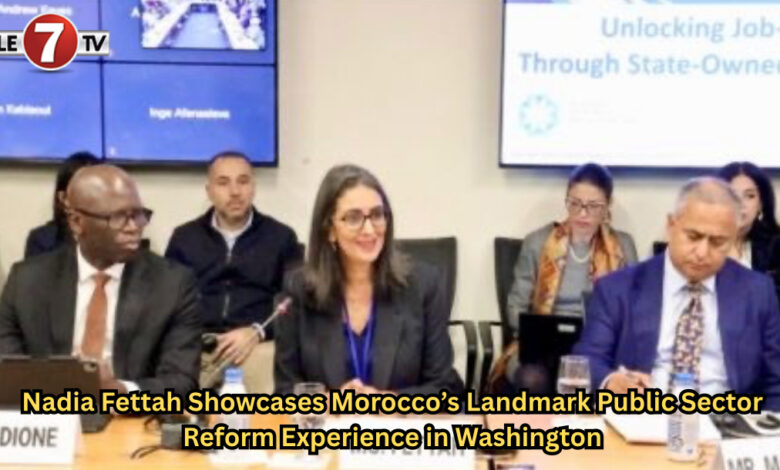
Speaking during a panel titled “Job-Creating Systems Through SOE Reform”, organized by the World Bank Group as part of the Annual Meetings of the IMF and the World Bank, Fettah emphasized the pivotal contribution of Moroccan public enterprises to employment creation and infrastructure development.
According to the minister, Morocco currently has around sixty commercially oriented public enterprises, which generate a combined turnover of nearly 25 billion dollars and an average profitability of 40 percent.
She noted that since 2021, Morocco has been implementing major reforms under the leadership of the National Agency for the Strategic Management of State Holdings and the Monitoring of Public Enterprises and Establishments (ANGSPE). These reforms aim to strengthen good governance and gender representation, with women now accounting for 30 percent of board members across public enterprises. This progress, she said, has helped instill a stronger sense of discipline, dialogue, and accountability within decision-making bodies.
Fettah also underscored the strategic role of EEPs in Morocco’s current economic momentum, particularly in infrastructure expansion. She cited the example of the National Office of Electricity and Drinking Water (ONEE), which has enabled Morocco to reach a 99 percent electrification rate, a figure among the highest in Africa.
Other major public enterprises were highlighted as well, including the OCP Group, Tanger Med, and Masen (Moroccan Agency for Sustainable Energy), which serve as key engines of Morocco’s industrial, logistical, and green energy transformation.
The Minister further stressed the importance of governance reforms, particularly in terms of transparency, diversity, and efficiency within boards of directors.
She concluded by noting that the upcoming adoption of IFRS accounting standards (International Financial Reporting Standards) marks a significant step forward in enhancing financial transparency and international credibility for Morocco’s public enterprises.
Through these ongoing reforms, Morocco continues to position its public sector as a driving force for sustainable growth, competitiveness, and job creation, earning recognition from global financial institutions for its forward-looking approach.
Editorial team/le7tv