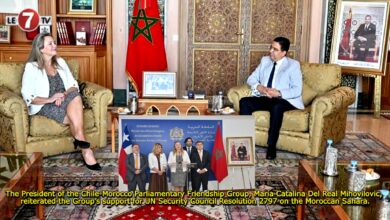
United Nations Resolution on the Moroccan Sahara, strategic alliances, soft power and assumed leadership: 2025, the year of the Kingdom’s diplomatic triumph
Decisive UN resolution, rallying of influential powers, strategic breakthroughs in Africa, Europe and Latin America, affirmation of an assumed soft power: in 2025, Moroccan diplomacy did not simply record successes, it imposed a method and redefined the balances. Under the impetus of His Majesty King Mohammed VI, the Kingdom made clarity on the Sahara, consistency in alliances and strategic pragmatism the pillars of a foreign policy that is now readable, respected and effective.

Far from improvised displays, Rabat rolled out a diplomacy of depth, based on anticipation, credibility and continuity. A diplomacy in which the Moroccan Sahara remains the compass, and in which the levers of soft power, sport, culture, South-South cooperation, extend the action of the State on all continents.
A year marked by major turning points
The year 2025 was built as a succession of structuring milestones. On 28 April, at the Royal Palace in Rabat, His Majesty King Mohammed VI receives the Ministers of Foreign Affairs of Burkina Faso, Mali and Niger, members of the Alliance of Sahel States. At the heart of the exchanges, a strong strategic initiative: to offer the Sahel structured access to the Atlantic Ocean, breaking landlocked isolation and redrawing the routes of regional stability.
On 1 June, a major diplomatic threshold is crossed: the United Kingdom officially recognizes the Moroccan autonomy plan as “the most credible, viable and pragmatic solution” to the regional dispute over the Sahara. A position heavy with meaning, coming from a permanent member of the UN Security Council.
On 23 September, in New York, Paraguay affirms its support for Morocco’s sovereignty over its Sahara and mentions the opening of a consulate in the southern provinces. On 26 November, the European Parliament rejects an attempt to challenge the EU-Morocco agricultural agreement, consolidating the economic integration of the Sahara into the Euro-Moroccan partnership.
All these sequences, taken together, outline a coherent, methodical and sovereign diplomacy, advancing without noise but with formidable effectiveness.
31 October 2025: the resolution that enshrines a historic turning point
The high point of this exceptional diplomatic year occurs on 31 October 2025. On that day, the United Nations Security Council adopts Resolution 2797, enshrining for the first time the Moroccan autonomy initiative as the only serious and credible basis to reach a lasting political solution to the regional conflict.
Adopted by 11 votes in favor and 3 abstentions, this resolution marks a historic shift after more than five decades of stalemate. “There will now be a before and an after 31 October 2025,” declares His Majesty King Mohammed VI in a solemn speech, affirming the unity of the Kingdom “from Tangier to Lagouira.”
In the streets of Rabat, Casablanca, Laayoune or Dakhla, scenes of popular jubilation testify to a shared feeling: that of a diplomatic victory patiently built and internationally enshrined.
Morocco, a central player in UN diplomacy
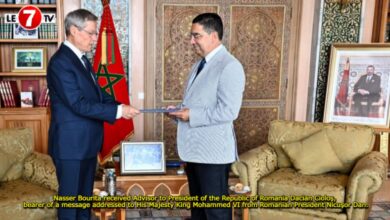
In New York, Morocco asserts itself in 2025 as a major player in global diplomacy. During the 80th UN General Assembly, the Kingdom multiplies bilateral meetings, multilateral initiatives and strategic agreements. Digital hub with UNDP, leadership on the links between sport and migration, strengthened South-South cooperation, revival of the Atlantic initiative, extension of the “Women, peace and security” plan: Rabat combines the defense of its sovereign interests with active contribution to major global issues.
Resolution 2797 also introduces a new legal reading, integrating self-determination into a logic of political participation within an established sovereignty. An evolution in line with the standards of comparative international law and which strengthens the centrality of the Moroccan solution.
The consecration of strategic patience
Two days after the vote, Foreign Minister Nasser Bourita sums up the sequence: “We have emerged from the cycle of the impossible referendum.” The autonomy initiative, presented in 2007, has established itself over the years as the unique and realistic framework for settlement.
This success is the result of an assumed strategic patience, carried out under the direct supervision of His Majesty King Mohammed VI, based on the methodical accumulation of support and anchoring in international legality. The explicit inclusion of Algeria as a stakeholder puts an end to a diplomatic fiction maintained for years and durably rebalances the political process.
An international domino effect
From London to Asunción, from Brussels to Madrid, 2025 consecrates a diplomatic domino effect. Europe consolidates its structuring partnership with Rabat, Latin America reassesses its positions, and the Sahelian Africa finds in the Moroccan offer a credible alternative to isolation and instability.
The partnership with Spain, strengthened during the 13th High-Level Meeting, illustrates this dynamic: fourteen sectoral agreements signed and a clear reaffirmation of the autonomy plan as a realistic basis for settlement.
Sport and culture: the quiet strength of Moroccan soft power
In 2025, Morocco also confirms its status as an emerging sporting and cultural power. On the strength of its historic football performances, the Kingdom hosts the 2025-2026 Africa Cup of Nations, transforming the event into a showcase of modernity, stability and organizational know-how, five years before the 2030 World Cup.
On the cultural level, the inscription of the Moroccan caftan in UNESCO’s intangible heritage strengthens the Kingdom’s diplomacy of influence, projecting a plural, rooted and universal identity.
A hand extended, a diplomacy that changes scale
Finally, faithful to its doctrine of peace and good neighborliness, Morocco reaffirms in 2025 its outstretched hand to the Maghreb. In the Throne Speech of 29 July, His Majesty King Mohammed VI again calls for the normalization of relations with Algeria, without renouncing the firm defense of national interests.
In 2025, Moroccan diplomacy did not change course: it changed scale. It moved from managing balances to redefining them. The coming challenge is now clear: to translate political gains into lasting settlements, and to transform symbolic victories into concrete realities, in the service of regional stability and shared development.
Translated from Abderrazzak Boussaid’s French article – le7tv