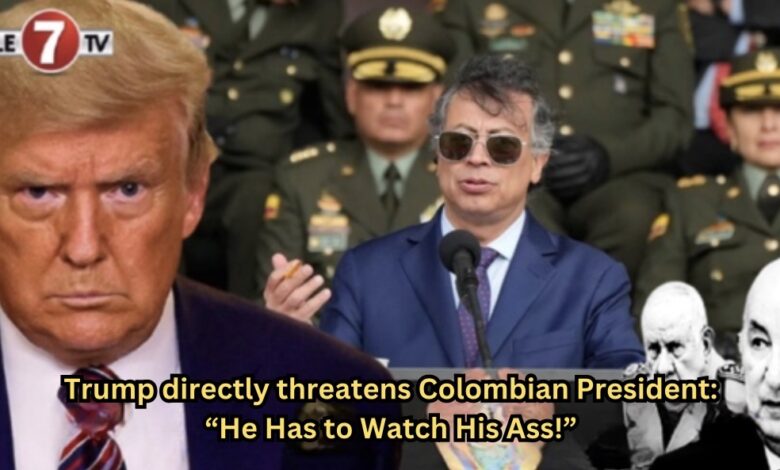
Trump directly threatens Colombian President: “He Has to Watch His Ass!”
The Algerian military regime in panic over the collapse of its Latin American allies

The political earthquake caused by the spectacular capture of Nicolás Maduro in Venezuela and his exfiltration to the United States continues to send shockwaves far beyond Caracas. In Algiers, within military power circles, concern is palpable: one by one, the “rogue friends” of the Algerian regime are falling or faltering, taking with them an entire ideological axis hostile to Morocco and regional stability.
During a long and fiery press conference, Donald Trump confirmed that the operation against Maduro was only a first strong signal. The American president directly threatened Colombian President Gustavo Petro, warning him to “watch his ass,” implying that Washington is leaving no option off the table regarding leaders he accuses of collusion with transnational criminal networks.
Under the pretext of combating drug trafficking, but with a clear eye on Venezuela’s vast oil reserves, Donald Trump justified the American intervention as necessary to put an end to what he calls “narco-states.” Gustavo Petro is now squarely in the sights. The U.S. president accused him bluntly of overseeing cocaine production infrastructure destined for the North American market: “He’s making cocaine and they’re sending it into the United States, so he does have to watch his ass.” Trump said, delivering a barely veiled warning.
These statements immediately escalated tensions between Washington and Bogotá. Colombia announced the deployment of troops to its border with Venezuela, while Gustavo Petro, ideologically close to Nicolás Maduro, denounced an alleged American “missile attack,” claiming an affront to Latin American sovereignty and raising the specter of a humanitarian crisis.
Algiers loses its rogue friends
For the Algerian military regime, this sequence is a true strategic nightmare. Nicolás Maduro and Gustavo Petro were among the loudest supporters of the Polisario separatists, serving as diplomatic conduits for Algiers to attempt to undermine Morocco’s sovereignty over its Sahara. The fall of the first and the weakening of the second mark a major setback for this diplomacy of hostility and alignment with contested regimes.
As these ideological allies collapse or come under international pressure, Algiers finds itself more isolated than ever, trapped in an obsolete strategy based on dubious alliances and lost causes. The wind of history is now blowing in the opposite direction, and the Algerian military regime seems well aware that the end of impunity for its partners could ultimately call its own certainties into question.
While some tremble, Morocco advances, strengthened by credible alliances, pragmatic diplomacy, and increasingly consolidated international legitimacy.
Translated from Abderrazzak Boussaid’s French article – le7tv