A Free and Independent Kabylia Defies an Algerian Power at the End of Its Tether
Paris was, on December 14, 2025, the stage for a moment that Kabyle activists already describe as historic and irreversible. Gathered near the Arc de Triomphe, a universal symbol of freedom and resistance, leaders of the Movement for the Self-Determination of Kabylia (MAK) officially proclaimed the birth of the Federal Republic of Kabylia, marking a major political rupture with the Algerian state.

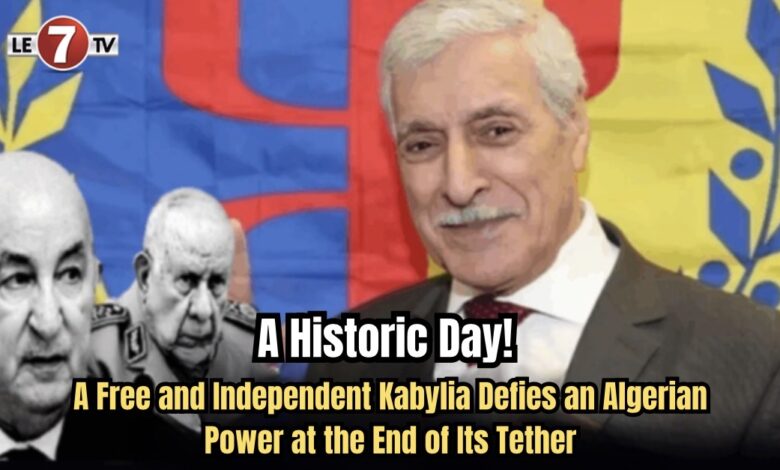
To sustained applause from an audience that had come from several countries, Ferhat Mehenni was recognized as president of the new Republic, before the Kabyle national anthem rang out. A powerful, solemn sequence, heavy with meaning, consecrating decades of identity-based, cultural and political struggle against an Algerian central power accused of oppression, denial and systematic repression.
A Proclamation Maintained Despite Pressure and Maneuvers from Algiers
Initially scheduled to take place at the Palais des Congrès in Versailles, the ceremony was banned by the prefectural authorities, officially for reasons of public order. A decision perceived by the organizers as the result of indirect diplomatic pressure exerted by the Algerian regime, known for attempting to export its censorship beyond its borders.
Undeterred, and true to its determination, the MAK maintained the event in a private venue, in strict compliance with French law. A reinforced security setup was deployed, as attempts at disruption, attributed to relays of the Algerian regime within the diaspora, were reported. These were all revealing signs of the tension gripping an Algerian power worried and unable to respond politically to the Kabyle question by any means other than intimidation.
From Identity Claim to Foundational Political Act
This proclamation marks a decisive turning point. For the first time since Algeria’s independence, a structured movement, equipped with a clear political leadership, has taken the step of a sovereign act. Kabylia is no longer content with asserting its culture or its language; it is affirming its right to self-determination, directly addressing the international community.
Foreign parliamentarians, civil society actors, human rights activists and international figures welcomed this initiative, emphasizing the peaceful, political and democratic nature of the Kabyle démarche. The strong media and digital resonance of the event demonstrates that the Kabyle question is no longer confined to the margins of international debate.
The Algerian Regime Confronted with Its Contradictions
This symbolic birth of the Federal Republic of Kabylia comes at a time when the Algerian regime is multiplying arrests, political trials and arbitrary convictions against Kabyle activists, journalists and intellectuals. By criminalizing any autonomist expression, Algiers reveals its inability to manage diversity, preferring repression over dialogue, and force over democracy.
The irony of history is striking: a regime that positions itself as a champion of self-determination abroad stubbornly refuses this right to one of its own peoples.
A New Page in North African History
The proclamation of the Federal Republic of Kabylia opens a new political phase, both for Kabylia and for Algeria. It now places the Algerian regime face to face with a reality it can no longer sweep aside through security measures alone: the Kabyle question has become international.
In Paris, far from censorship and repression, Kabylia spoke with one voice. And regardless of what Algiers may say, that voice can no longer be silenced.
Translated from Abderrazzak Boussaid’s French article – le7tv