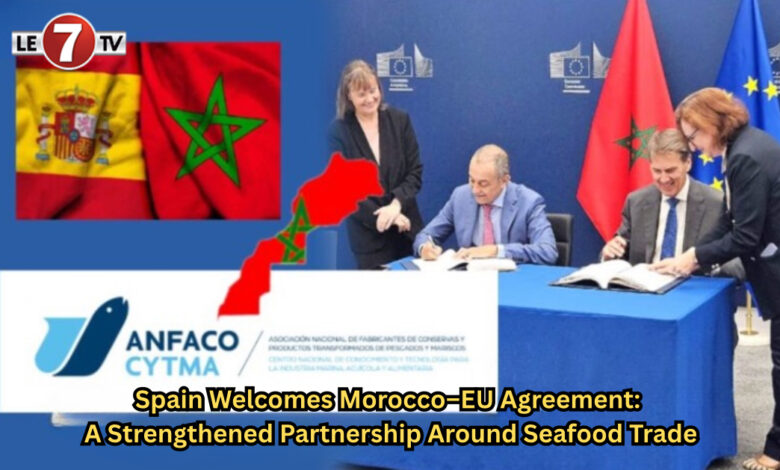
Spain Welcomes Morocco–EU Agreement: A Strengthened Partnership Around Seafood Trade
The Spanish National Federation of Seafood and Canned Fish Manufacturers (ANFACO-CYTMA) has expressed strong satisfaction following the conclusion of a new agreement between the Kingdom of Morocco and the European Union. The accord ensures the continued preferential access of products originating from Morocco’s southern provinces to the European market, on the same terms as those from other regions of the Kingdom.

In an official statement, the Spanish professional federation noted that the agreement comes at a critical moment:
“The European Court of Justice ruling, which was set to take effect last Saturday, would have removed the tariff advantages granted to Morocco under the partnership agreement for products originating from the Sahara. According to our estimates, this decision could have caused losses exceeding 30 million euros per year due to additional customs duties,” ANFACO-CYTMA explained.
In response to the situation, the federation worked closely with the Spanish government and the European Commission to maintain trade stability and ensure the uninterrupted supply of raw materials essential to Spain’s seafood processing industries.
The association recalled that imports from Morocco’s southern provinces are a key pillar of Spain’s seafood sector. In 2024 alone, Spain imported more than 29,000 tons of octopus, 15,000 tons of sardines, 20,000 tons of squid, and 3,000 tons of shrimp, with a total value exceeding 610 million euros. These figures highlight the strategic importance of the region in Morocco–Spain fisheries trade.
Roberto Alonso, Secretary-General of ANFACO-CYTMA, praised the responsiveness of European institutions:
“We went through a period of great uncertainty, but the situation was resolved at the last minute. Spanish factories need a stable legal framework and regulatory security to continue operations and guarantee consumers access to sustainable and affordable seafood,” he said, adding:
“We appreciate the European Commission’s flexibility in handling this complex issue. Morocco remains a key partner, providing us with essential raw materials such as octopus, sardines, squid, and frozen calamari.”
This agreement once again reaffirms the strength of the economic and commercial partnership between Morocco and the European Union, as well as the growing recognition of the Kingdom’s role as a major global player in the seafood industry.
Editorial team/le7tv