Morocco, Ethiopia Sign Two Religious Cooperation Agreements
Addis Ababa - The Ministry of Habous and Islamic Affairs and the Supreme Council for Islamic Affairs of Ethiopia signed two cooperation agreements in the religious field on Thursday in Addis Ababa as part of efforts to strengthen relations between the two countries and in accordance with the enlightened vision of His Majesty King Mohammed VI, Commander of the Faithful.

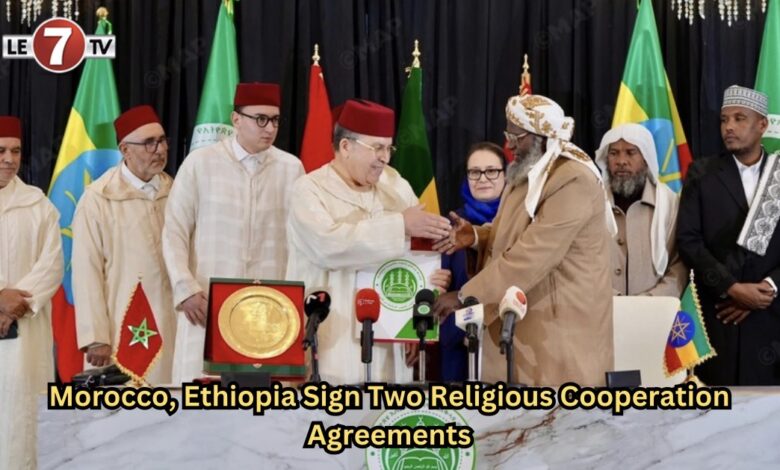
The first agreement, which received the High approval of His Majesty King Mohammed VI, Commander of the Faithful, aims to train 200 Ethiopian imams at the Mohammed VI Institute for the Training of Imams, Morchidines, and Morchidates in Rabat over a period of five years, using a rigorous scientific and pedagogical approach aimed at establishing moderation and balance, strengthening spiritual security, and spreading the values promoted by Islam.
The second agreement is a memorandum of understanding aimed at exchanging experiences and expertise in the field of religious affairs management and continuing education, and strengthening cooperation between the ulema of both countries, through the Mohammed VI Foundation of African Ulema and the Supreme Council for Islamic Affairs of the Republic of Ethiopia, in the service of the Islamic religion, the unification of the efforts of the ulema, and the dissemination of the values of tolerance and coexistence.
The signing of these two agreements reflects the depth of the religious and scientific ties that unite the Kingdom of Morocco with the Federal Democratic Republic of Ethiopia and its African extension.
In this context, Sheikh Haji Ibrahim Tufa, President of the Supreme Council for Islamic Affairs of the Republic of Ethiopia, highlighted the leading role played by the Kingdom, under the enlightened leadership of His Majesty King Mohammed VI, Commander of the Faithful, in serving the Islamic religion and strengthening African cooperation based on science, wisdom, unity, and shared values.
He also noted that the Mohammed VI Foundation of African Ulema, under the enlightened leadership of His Majesty King Mohammed VI, Commander of the Faithful, has become a true scientific and spiritual reference on the African continent.
For his part, Mohamed Rifki, Secretary General of the Mohammed VI Foundation of African Ulemas, noted that the signing of these two agreements is part of efforts to strengthen religious and scientific cooperation between Morocco and Ethiopia, and is in line with the vision of His Majesty King Mohammed VI, Commander of the Faithful.
As for the memorandum of understanding, it will enable 60 Ethiopian executives to benefit from comprehensive training in Morocco in two phases and to learn about the experience accumulated by the Kingdom of Morocco over more than 13 centuries in the religious field, he added.
Editorial team/le7tv