Morocco–Mexico: Partnership Opportunities Highlighted in Mexico City
The many partnership opportunities available to Morocco and Mexico, driven by the dynamic launched by the Kingdom to harness the maritime potential of its Atlantic façade, were highlighted during a conference held in Mexico City.

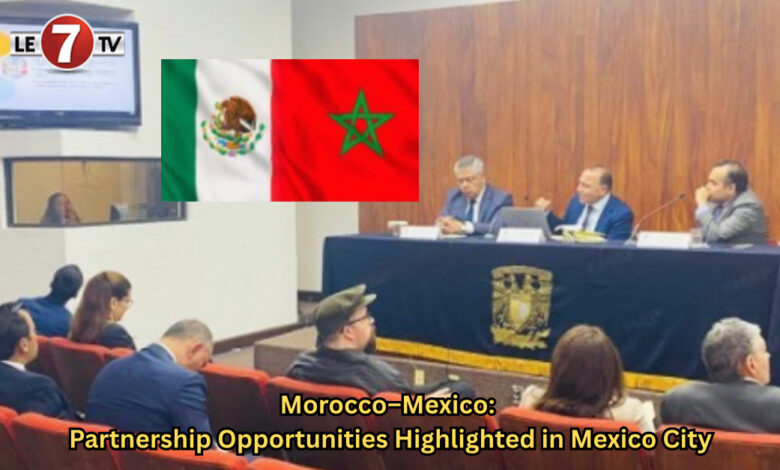
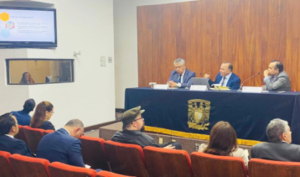
Organized by the Mexican Observatory of the Moroccan Sahara at Panamerican University, the event was an opportunity to review large-scale projects launched in Morocco to accelerate the development of its Atlantic coast, in particular the Dakhla Atlantic Port.
Speaking on the occasion, Hamid Aboulas, President of the Center for Ibero-American and Atlantic Studies on Governance and Sustainable Development, noted that these new infrastructures provide “a major logistical platform from which Mexico can benefit to develop a strategic partnership with Morocco.”
Rabat and Mexico can capitalize on these structuring projects to promote the integration of their economies and strengthen cooperation in the service of common interests, said the public law professor at Abdelmalek Essaadi University in Tetouan.
At this conference, held under the theme “Morocco and Mexico: Shared Present and Future”, the academic emphasized that these projects concern port infrastructure, renewable energies and sustainable development — all sectors likely to foster mutually beneficial cooperation.
Referring to the Initiative launched by His Majesty King Mohammed VI to facilitate Sahel countries’ access to the Atlantic Ocean, the speaker stressed that this initiative opens significant prospects for African and Latin American countries to benefit from Morocco’s maritime façades and their modern infrastructures, through strategic projects designed to strengthen South-South cooperation, particularly in the economic and trade fields.
Mr. Aboulas also underlined the complementarities and similarities between Morocco and Mexico, particularly their strategic geographical positioning within their respective regions.
In this regard, he drew a parallel between Mexico’s federal system and Morocco’s advanced regionalization process, noting that both mechanisms guarantee good governance and the involvement of local populations in managing their own affairs. In both systems, he said, citizens elect their representatives democratically.
He added that sharing legislative and institutional expertise in territorial governance could strengthen cooperation between Morocco’s regions and Mexico’s federal states, particularly in spatial planning, sustainable development, local governance and vocational training, as well as the training of local officials and elected representatives of both countries.
The Moroccan academic further pointed out that Mexico and Morocco have, over recent decades, experienced political and institutional progress marked by the entrenchment of democracy and decentralization. Despite their different historical backgrounds, both nations, he stressed, aspire to build stronger democratic institutions and lay the foundations for effective territorial governance.
Speaking at another conference at Panamerican University in Mexico City, also initiated by the Mexican Observatory of the Moroccan Sahara, Mr. Aboulas noted that at a time when desert regions across the world are severely challenged by climate change and water stress, Mexico and Morocco’s regions of Dakhla-Oued Eddahab and Laayoune-Sakia El Hamra stand out as models of environmentally respectful and socially beneficial sustainable development.
This innovative model, he continued, is characterized by an investment dynamic focused particularly on the promotion of clean energy, drought-resistant crops, eco-tourism and seawater desalination projects.
These two conferences are part of the regular series of meetings organized by the Mexican Observatory of the Moroccan Sahara, with the participation of Mexican diplomatic, political and academic figures.
The Observatory also holds forums for legislative and diplomatic dialogue and organizes academic and research programs showcasing the broad-based development dynamic in Morocco’s southern regions, as well as opportunities for cooperation and economic integration, particularly between Africa and Latin America.
Editorial team/le7tv