Casablanca Settat: the “Healthy City” at the heart of a conference on new models of territorial development
A conference on the theme “The place of the Healthy City in integrated territorial development programs” was held on Saturday at the headquarters of the Casablanca Settat region, bringing together experts, academics and institutional stakeholders to discuss the challenges of urban health and its integration into planning and territorial development policies.

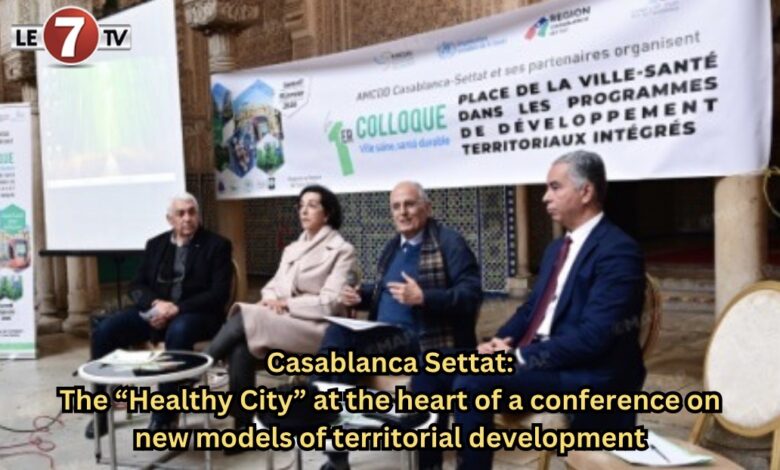
The conference, organized by the Moroccan Alliance for Climate and Sustainable Development (AMCDD) and its partners, aims to promote new urban models that are favorable to health, capable of protecting against pollution, encouraging physical activity, mitigating the effects of climate change and strengthening well being.
Speakers stressed that more than 60 percent of the national population now lives in urban areas, making cities a strategic space where many determinants of health are concentrated, including air, water and soil quality, mobility, housing, waste management, exposure to noise and heat stress, as well as access to natural spaces and physical activities.
Participants also noted that health, as a factor of social cohesion, is a powerful driver of economic attractiveness for territories, and called for constant dialogue between health actors and urban planning decision makers.
On this occasion, the representative of the World Health Organization in Morocco, Dr Mondher Lataief, recalled that the global “Healthy City” initiative aims to support local authorities in implementing multisectoral actions designed to improve the overall health of urban populations.
This initiative, he added, is based in particular on the promotion of green spaces, the fight against air pollution, the development of soft mobility and the prevention of communicable diseases.
For his part, Abdelahad Fassi Fihri, former Minister of National Territorial Planning, Urban Development, Housing and City Policy, stressed the importance of continuing to reflect on the evolution of architectural and urban models, with a focus on how well they meet the needs of populations and their well being.
He highlighted the need to anchor these orientations within a comprehensive ecological policy capable of supporting sustainable urban development.
For her part, Professor Rajae El Aouad, president of the One Health Morocco association, highlighted the “One Health” approach as an integrated framework to better understand the interactions between human, animal and environmental health in urban settings.
She stressed that rapid urbanization increases health risks linked to pollution, zoonotic diseases, heat islands and social inequalities, calling for cross cutting public policies based on integrated governance, shared health surveillance and citizen participation.
In a statement to MAP, Jemmâ El Mehdi, AMCDD Casablanca Settat coordinator, said that this first conference devoted to the “Healthy City” aims to raise awareness of the challenges of this concept and to advocate for its integration into integrated territorial development plans, so as to place health at the heart of urban policies.
The conference thus laid the foundations for interdisciplinary reflection on the city of tomorrow, highlighting innovative approaches designed to strengthen territorial resilience, improve citizens’ quality of life and build healthier, more sustainable and more inclusive cities.
Editorial team/le7tv