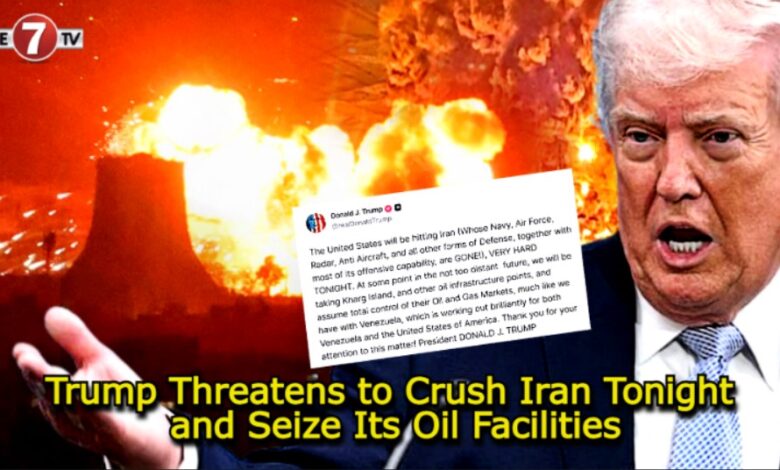
U.S. President Donald Trump vowed on Thursday to strike Iran “very hard” later in the evening and threatened to take control of the country’s oil facilities, following a new wave of overnight attacks between the two sides. Tehran, meanwhile, now considers the theoretical ceasefire to be “virtually meaningless.”
“The United States will hit Iran… VERY HARD tonight,” the American president wrote on his Truth Social platform, as hostilities have openly resumed in recent days, more than three months after the conflict began.
“In the fairly near future, we will take Kharg Island, along with other oil infrastructures,” he added. At the end of March, Trump had already threatened to “obliterate” Iran’s main oil export terminal, which was struck in early April, although he had not then mentioned taking control of it.
The Middle East ceasefire, which came into effect on April 8 and had been largely respected until last weekend, is now “virtually meaningless,” Iran’s Foreign Ministry said earlier in the day.
“It is difficult to remain optimistic,” Pakistan, the main mediator, acknowledged, calling for diplomacy and dialogue, a position later echoed by Moscow, Beijing, Ankara, and Riyadh.
Although Qatari negotiators remained in Tehran until Thursday morning for talks reportedly coordinated with Washington, a diplomatic source said there is currently no prospect of an agreement.
The United States and Iran had already exchanged attacks during the night from Tuesday to Wednesday. The U.S. military announced that it had targeted “military surveillance facilities, communication systems, and Iranian air defense sites across the country,” expanding operations beyond the southern regions targeted the previous day.
According to Iranian media, three people were injured, with explosions reported on Qeshm Island, in Minab, Sirik, and the port city of Bandar Abbas in the south, as well as in locations much closer to the capital.
In Tehran, Majid, a 35-year-old pharmacist, said he was “deeply worried.”
“The gap between the two countries is too wide to hope for a diplomatic solution,” he said, pointing to soaring prices and lost income that have affected daily life.
Iran retaliated by launching around twenty missiles toward a U.S. base in Azraq, Jordan—all of which were intercepted—and once again targeted the Gulf monarchies.
In Bahrain, a child was injured by drone debris, while authorities reported more than 36 drone attacks in total. Kuwait briefly closed its airspace following the strikes.
Trump’s 38th Promise
On Tuesday, Donald Trump had promised that an agreement with Iran was imminent—for the 38th time since the conflict began, according to a CNN tally—before reversing course the following day.
“We were really close to reaching a deal, but they keep stringing us along. They’re making fools of us,” he told reporters.
The strategically vital Strait of Hormuz, through which one-fifth of the world’s oil and gas supplies passed before the war, has once again become a focal point of tensions. Iran’s maritime authority confirmed that the waterway would be completely closed “until further notice,” after the military had announced the measure earlier. Previously, around twenty ships a day had still been allowed to transit.
Iran has effectively sealed off the strait since the conflict erupted on February 28, while the United States has responded by imposing a blockade on Iranian ports.
The U.S. Central Command (CENTCOM) announced on Thursday that it had intercepted another tanker off the coast of Oman that was allegedly attempting to bypass the restrictions. The vessel’s engine room caught fire, and the crew was evacuated. The previous day, U.S. forces had targeted another ship, killing three Indian sailors.
The worsening crisis in the Gulf has kept oil prices at elevated levels. On Thursday, Brent crude, the international benchmark, was trading around $92 per barrel, compared with $70 before the war.
The conflict reignited on Sunday when Iran launched missiles at Israel for the first time since the beginning of the fragile truce, in retaliation for Israeli strikes on Beirut.
Tehran, the principal backer of Lebanon’s Hezbollah movement, insists that any agreement aimed at ending the Middle East war must also include Lebanon, whose future Washington reportedly prefers to address separately.
Israel responded to the Iranian missile attacks before both adversaries announced a suspension of hostilities, as requested by Donald Trump.
Lebanon was drawn into the conflict on March 2, when Hezbollah launched attacks against Israeli territory in support of Iran. Since then, Israel has carried out extensive military operations in the neighboring country, stating that it seeks to “eliminate” the Shiite movement. According to available reports, these operations have killed more than 3,600 people, mainly in southern Lebanon, where Israeli forces now control part of the territory.
Editorial Staff / Le7tv