The Presidency of the Public Prosecutor’s Office issues a circular on the provisions governing cheques under the Commercial Code
The Presidency of the Public Prosecutor’s Office has issued a circular concerning the amending and supplementary provisions relating to cheques, introduced by Law No. 71.24 amending and supplementing Law No. 15.95 forming the Commercial Code, as published in Official Bulletin No. 7478 dated 9 Chaabane 1447 (29 January 2026).

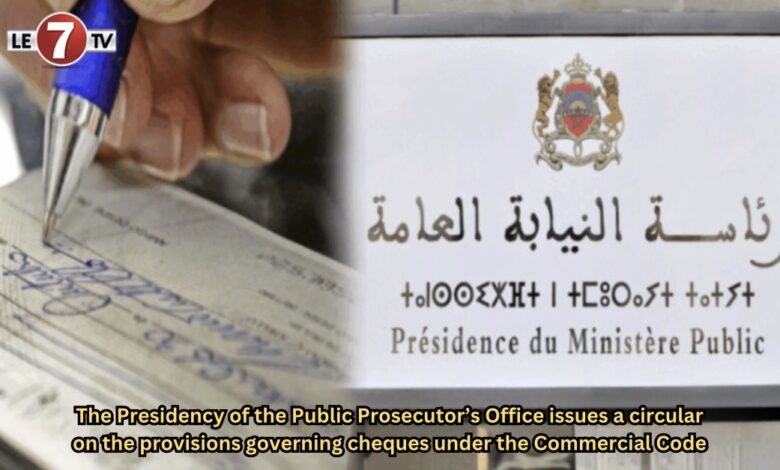
Addressed in particular to the Prosecutor General before the Court of Cassation, the Prosecutors General before the Courts of Appeal, and the King’s Prosecutors before the Courts of First Instance, the circular states that this law, which entered into force upon its publication in the Official Bulletin, introduces significant new provisions with a direct impact on the work of the Public Prosecutor’s Office at all stages of criminal proceedings. It notably establishes legal mechanisms allowing the drawer of a cheque who has failed to provide sufficient funds to regularize their situation, whether at the stage of the preliminary investigation, judicial investigation, trial, or even after a final judicial decision has been issued.
The circular explains that, with regard to the conditions for prosecution and grounds of justification, the law has introduced substantial changes to the rules governing the initiation of public prosecution for the offence of issuing a cheque without sufficient funds at the time of presentation for payment. Article 325 of the Commercial Code now makes prosecution subject to the existence of a prior legal condition, namely a formal notice served on the drawer by a judicial police officer, upon instructions from the Public Prosecutor’s Office, in order to allow the drawer to regularize their situation within a period of 30 days from notification.
The circular adds that, following this formal notice, the drawer may be subject to one of the judicial supervision measures provided for under Article 161 of the Code of Criminal Procedure, including electronic monitoring by bracelet. This period may be extended by an additional 30 days with the consent of the beneficiary of the cheque.
It is also specified that payment of the cheque amount or withdrawal of the complaint by the beneficiary now constitutes a legal impediment to the initiation of prosecution against the drawer who failed to constitute or maintain sufficient funds, provided that the latter pays a fine equivalent to 2 percent of the cheque amount or the established shortfall.
In this context, if payment or withdrawal occurs, the drawer is required to pay the statutory fine provided for under Article 325 of the Commercial Code to the court registry, which results in the complaint being closed. However, if the drawer refuses to appear or is unable to pay the fine, this refusal must be recorded in the hearing report prior to the initiation of public prosecution.
The law has also introduced new grounds of justification, rendering the offence of insufficient funds or failure to constitute funds at the time of presentation of the cheque for payment non-existent when the cheque is issued between spouses, or between ascendants and descendants in the first degree. The legislator used the expression “there is neither crime nor punishment”, which leads to the non-existence of the offence provided for in paragraph 1 of Article 316 of the Commercial Code. These grounds of justification remain applicable between spouses for a period of four years following the dissolution of the marital bond.
With regard to criminalization and penalties, the circular notes that the law has amended the penalties provided for several offences set out in Articles 316, 318 and 319 of the Commercial Code, both in terms of custodial sentences and the amount of fines.
Regarding the grounds for extinction of public prosecution, suspension or cessation of the execution of the sentence, the circular highlights that Law No. 71.24 introduced significant new provisions concerning the effects of settlement or withdrawal of the complaint, both on public prosecution and on the execution of penalties.
In order to ensure optimal implementation of these new provisions, the President of the Public Prosecutor’s Office called on the recipients of the circular to ensure their application with seriousness and effectiveness.
He recalled that these amendments were published in the Official Bulletin on 29 January 2026 and entered into force immediately on that date. He stressed the need for vigilance in applying these new provisions and for taking into account their legal effects on ongoing proceedings. Accordingly, the procedural provisions set out in Law No. 71.24 apply immediately, while prosecutions initiated before 29 January 2026 are not subject to the new formalities, particularly the requirement of prior formal notice. However, persons already convicted whose cases are still pending benefit from the new guarantees relating to the conditions of public prosecution and the suspension of the execution of the sentence in the event of payment of the cheque or withdrawal of the complaint.
Finally, he specified that substantive provisions apply to all ongoing prosecutions in accordance with the principle of the criminal law more favorable to the accused, even when public prosecution was initiated under the previous legislation.
Editorial team/le7tv