Iran: The collapse of the Ayatollahs signals the end of the “Axis of Evil” and shakes the Algerian military regime
The Iranian theocratic regime is likely living its final hours. After more than four decades of repression, ideological lies and institutionalized violence, the Islamic Republic is faltering under the combined pressure of its own people, international isolation and the gradual collapse of its regional relays. In the streets of Tehran, Isfahan, Shiraz and Mashhad, fear has changed sides: it is now the ayatollahs who are trembling.

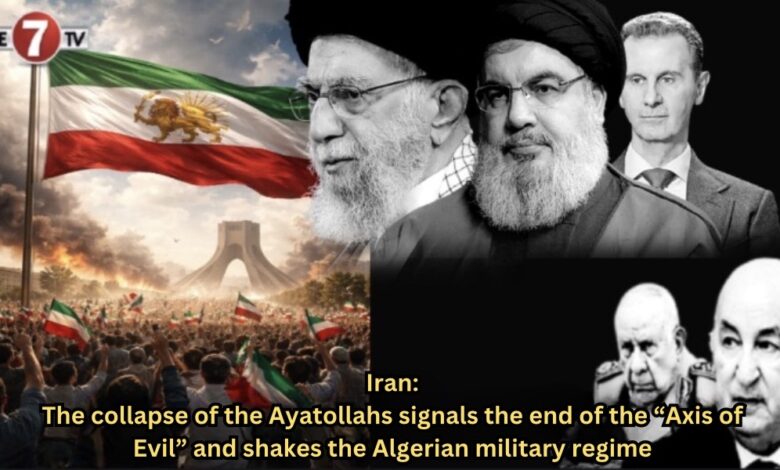
Since the death of Mahsa Amini, a tragic symbol of an oppressive system, the protest has continued to expand. Women, young people, workers and ethnic and religious minorities are converging in a frontal rejection of a power that no longer has anything to offer, neither prosperity, nor dignity, nor a future. The slogan “Woman, Life, Freedom” has cracked the very heart of the theocracy, revealing a worn out, brutal and ideologically bankrupt regime.
The hope of the return of the Pahlavis
In this chaos, one name keeps returning with insistence: Reza Pahlavi, son of the last Shah of Iran. Long relegated to the rank of historical nostalgia, the prince now embodies, for a growing part of Iranians, the alternative to the Islamist darkness imposed since 1979. His discourse, focused on secularism, democracy and national reconciliation, stands in sharp contrast to the archaic rhetoric of the mullahs.
The symbol is powerful: the possible return of the historic Iranian flag, stripped of the Islamist emblem, as a founding act of a new era. For the current regime, this prospect is a supreme humiliation, because it means the total failure of the “Islamic revolution” and the definitive rejection of its civilizational project.
The “Iran Hezbollah Syria” axis in ruins
On the regional level, Iran is now only a shadow of itself. Its “axis of resistance”, long brandished as a weapon of deterrence, is collapsing piece by piece. In Syria, the regime of Bashar al Assad, supported at great cost by Tehran, is exhausted and discredited. Lebanese Hezbollah, the historic proxy of Iran, is weakened politically, financially and militarily, and increasingly contested by Lebanese society itself.
Deprived of strategic depth, strangled by sanctions and confronted with unprecedented popular anger, the Iranian regime is no longer able to export its revolution or to mask its internal decay through external adventures.
Domino effect: Algiers in the line of fire
The imminent fall of the Ayatollahs is shaking other authoritarian regimes, starting with the Algerian military regime, an objective ally of Tehran in influence networks, anti Western rhetoric and support for destabilizing groups in the region. Undermined by a chronic economic crisis, systemic corruption and the total confiscation of power by a military mafia caste, the regime in Algiers fears a domino effect.
Because the end of the Iranian regime would send a clear message to oppressed peoples: even the most brutal dictatorships are not eternal.
The end of an era
History is turning a major page in the Middle East and North Africa. The announced fall of the ayatollahs would not only be the liberation of a martyred people, but the signal of a broader collapse of systems founded on fear, ideology and the confiscation of popular sovereignty.
The Iran of tomorrow could once again become a great nation, free, open and reconciled with its history. And with it, the entire edifice of regional chaos threatens to collapse.
Translated from Abderrazzak Boussaid’s French article – le7tv