Former Argentine Ambassador Ricardo Lagorio says Resolution 2797 marks “a major success” for Moroccan diplomacy under the leadership of King Mohammed VI
The adoption of United Nations Security Council Resolution 2797 on the Moroccan Sahara represents “a major success” for Morocco’s diplomacy, achieved under the leadership of His Majesty King Mohammed VI, said Ricardo Lagorio, Argentina’s former permanent representative to the United Nations.

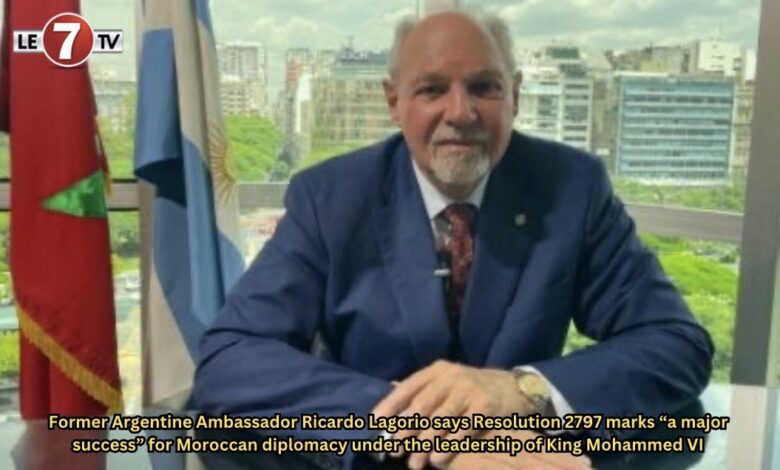
Speaking in an interview with MAP, Mr. Lagorio said this achievement reflects the vision and approach championed by Moroccan diplomacy. He described it as the result of sustained and determined action by the Kingdom and of its “unwavering commitment” to multilateralism.
The former ambassador, who also served as Argentina’s envoy to Russia, underlined the professionalism and sharp strategic sense of Moroccan diplomacy, which he called “extremely competent”.
For him, the way the Sahara issue has been handled at the UN shows the degree to which Morocco has established itself as a reliable and methodical diplomatic actor at a time of global tensions and rising polarization.
Mr. Lagorio highlighted the exceptional nature of Resolution 2797, adopted with 11 votes in favor, three abstentions and no opposition or veto. He noted that such a level of consensus is rare on sensitive issues before the Security Council.
He described the resolution as “a major diplomatic breakthrough”, crediting it to a Moroccan diplomatic effort that has been patient, deliberate and consistent over time.
According to Mr. Lagorio, this success reflects a long term effort led by His Majesty the King, in which Morocco has worked tirelessly until the approval of the resolution. Drawing on decades of experience with the multilateral system since his first assignment to the UN in 1982, he stressed that the outcome stands as a significant moment not only for Morocco but also for the credibility of multilateralism itself.
He remarked that Morocco has never abandoned the multilateral path in its pursuit of a just, lasting and acceptable solution to the Sahara issue. In his view, the Kingdom has shown that multilateralism remains the only framework capable of producing meaningful progress on complex questions in a world increasingly driven by unilateral actions.
The Argentine diplomat also noted that Morocco’s influence at the UN extends well beyond the Sahara dossier. He pointed to the country’s active and effective participation in global discussions on human rights, social and economic challenges, counterterrorism and digital governance.
He recalled that multilateralism is above all a “process”, one that requires time, coherence and persistence. Morocco, he said, has remained committed to that path. As an example, he cited the Moroccan American initiative on artificial intelligence within the Group of Friends of AI, which he described as a clear illustration of a country “that acts, proposes and builds”.
Mr. Lagorio concluded by noting that Morocco’s recent success at the Security Council should not be viewed in isolation. All of the diplomatic files pursued by the Kingdom, he said, contribute to strengthening the standing of its diplomacy.
He added that countries such as Argentina should pay close attention to this evolution, as Morocco has become an active, influential and essential diplomatic actor within multilateral institutions.
Editorial team/le7tv